Table of Contents
- Three rituals that really work
- More ritual ideas: movement, the senses, and the mind
- Why small rituals achieve more than big plans
- How to make a ritual actually stick
- Adapting rituals to every family stage
- When the evening doesn't cooperate: rituals for hard days
- Letting go of the guilt when the ritual doesn't happen
- Frequently Asked Questions
- Bottom line
Between dinner, brushing teeth, and bedtime stories, there's often little room left for a conscious transition into your own evening. Yet that transition is exactly what determines how restful the evening – and eventually your sleep – will be. Without that kind of cut, the day tends to slide straight from the last kid-related task into exhaustion, with nothing happening in between that was actually just for you.
The following rituals are deliberately kept small. They don't replace an extensive self-care routine, but create a noticeable cut between "family mode" and "your own time" – and as the sections below show, that cut can be shaped to fit almost any kind of evening. My personal take is that the smallness is the whole point – I've tried the elaborate versions, and they're the first thing to get skipped on a hard week.
Three rituals that really work
1. The deliberate change of scenery
As soon as the kids are asleep, switch rooms – even if it's just from the kids' room to the living room. The change of scenery marks a clear scene change for the brain, separating the room where parenting tasks just happened from the one that now belongs to you.
2. Ten minutes without a screen
Instead of reaching straight for your phone, deliberately wait ten minutes – with tea, a book, or simply in silence. This short pause is often more restful than an hour of scrolling, because it actually gives your mind a rest instead of feeding it new input.
3. A fixed closing thought
A short, always-the-same thought or sentence to close out the day – for example, "The day is done, tomorrow is new" – creates a mental full stop and makes it easier to let go. Of these three, this is the one I'd bet is most underrated, simply because it costs nothing and needs no props, yet it still marks the day as finished.
More Ritual Ideas: Movement, the Senses, and the Mind
The three rituals above are a good starting point, but not every evening calls for the same kind of transition. Some days the tension sits mostly in the body, other days it's the mind that won't quite switch off, and some evenings what's missing is simply a sensory cue that clearly marks the day as done. It helps to have a small repertoire of rituals on hand and pick whichever one fits how the evening actually feels. The ideas below are grouped along those same lines – a starting point for experimenting, not a checklist to get through in full.
Rituals for the body
After a day full of carrying, bending down, picking up toys, and chasing after little ones, tension tends to settle in the shoulders, neck, and lower back without you really noticing. A short physical ritual makes that tension noticeable – and gives it somewhere to go before you sit down for the rest of the evening.
- Two or three minutes of stretching on the living room rug, with no pressure to do it perfectly – just moving toward whatever feels good.
- A deliberately warm shower where the day is, quite literally, rinsed off, rather than treated as a means to an end.
- A short walk around the block, or at least a few minutes on the balcony, to get some fresh air and reset both body and mind.
- Rolling your shoulders and taking a few deep breaths while the kettle or the dishwasher runs.
Which movement feels right varies night to night – sometimes it's a quick stretch, sometimes just the deliberate walk from one room to the next, without tidying up along the way. What convinces me about the body-based rituals specifically is how little they ask of your mind – on the nights I have zero mental bandwidth left, moving is still somehow doable when thinking clearly isn't.
Rituals for the senses
Sensory cues often shift a mood faster than any thought can – a familiar scent or a certain kind of light can ease the switch from family mode into your own time almost automatically. A ritual built around one specific sense marks the evening off from the rush of the day without requiring much effort at all.
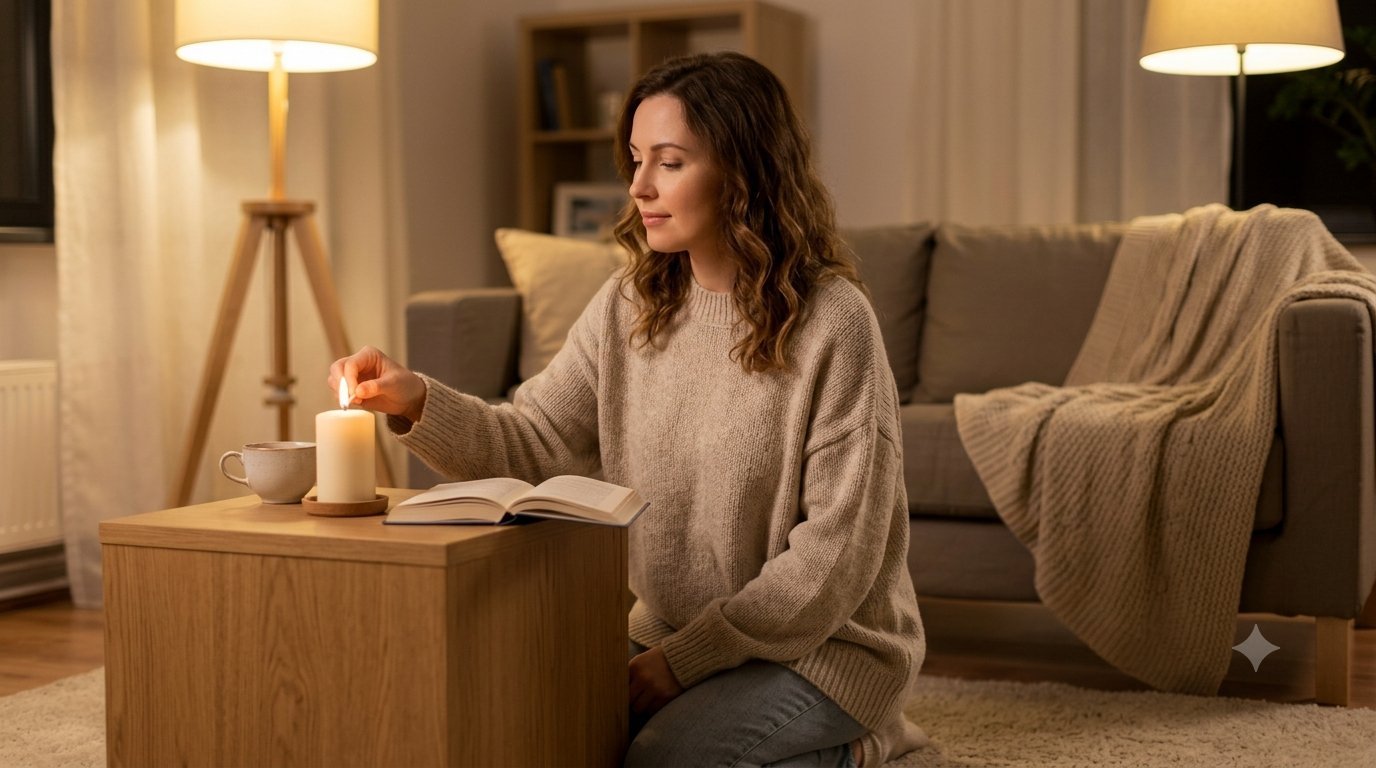
- Lighting a candle or adding a few drops of essential oil to a diffuser – over time, the scent itself becomes the signal that your time has started.
- A fixed evening playlist or podcast reserved only for this one hour and never played during the day.
- A warm drink, sipped slowly and on purpose, instead of going cold on the counter while you tidy up around it.
- Soft, dimmed light instead of the overhead lamp – that small shift alone tells your body the day is easing into evening.
Sensory rituals work best when they're reserved for the evening only – the same scent worn during the day loses its signal value fast. I'll admit the candle-and-scent approach is my personal favorite of the three categories, though I know plenty of moms who'd say the same about a fixed playlist instead – either way, the mechanism is the same.
Rituals for the mind
Sometimes the body has already settled while the mind is still running through tomorrow's to-do list. For those evenings, small reflective rituals give the mental loop somewhere to land before it carries on into bedtime.
- Jotting down three things that went well that day – even if it's just a quiet car ride or a lunch everyone actually finished.
- Writing a short "for tomorrow" list, so open tasks stop circling in your head and end up on paper instead.
- Summing up the day in a single sentence – said out loud, murmured quietly, or just thought.
- Taking a moment to name something to look forward to tomorrow, even if it's only the first quiet cup of coffee.
Combining rituals
These three categories – body, senses, and mind – aren't mutually exclusive. On especially draining evenings, it can even help to stack two short rituals back to back: rolling your shoulders first, say, then deliberately sitting down with a cup of tea. What matters more than the number is that the combination doesn't start feeling like one more program to get through. The moment a ritual starts feeling like an obligation rather than a rest, it's worth going back to a single, small element.
Why small rituals achieve more than big plans
- They're realistically doable even on exhausting days.
- Repetition builds a sense of security – the brain learns to recognize the evening as a time to recover.
- They don't require extra time, just a conscious use of the minutes you already have.
- They need no planning, preparation, or shopping list – they can be put into practice right away.
It's not about making every evening perfect. Even two out of three rituals, done consistently, make a noticeable difference. A big, elaborately planned self-care evening might sound nicer in theory, but in practice it often fails simply because it happens too rarely to ever become a reliable part of daily life. Small rituals don't have that problem – they're unobtrusive enough to keep running even in a packed week. Honestly, I'm not a fan of the "treat yourself" self-care culture that pushes big, occasional gestures – I'd rather have something small I actually do than something impressive I keep postponing.
How to Make a Ritual Actually Stick
Even the best ritual ideas don't help much if they fade out again after one good week. Making an evening ritual actually last – even once life gets busy again three weeks in – comes down to a few practical habits, regardless of which ritual you choose from above. None of them take extra effort; it's really about setting the ritual up so it doesn't need to be actively remembered at all.
Tie it to something you already do
A new ritual is far easier to keep when it attaches to something that already happens every evening anyway. If you always start the dishwasher before bed, that can become the trigger: as soon as it's running, the ritual begins. If you're always the one who does the last tuck-in, that moment can serve as the cue instead. The existing habit does the remembering for you – no extra alarm, app, or note on the fridge that eventually gets ignored. The more ordinary the trigger, the more reliably the pairing works, precisely because it never has to be consciously recalled.
Start smaller than feels necessary
The most common mistake with new rituals is planning them too big. Anyone who decides to fit in half an hour of yoga, a full journaling session, and a multi-step skincare routine every single evening will almost inevitably fail on a busy day – and once it fails once, the whole plan often gets dropped, not just that one evening. A more realistic ritual is one that still works on the most exhausted evening imaginable. Ten screen-free minutes are almost always possible; a half-hour wellness routine is not. The smaller the starting point, the better the odds it actually becomes a fixture – and a reliable mini-ritual can always be expanded later, once it's proven itself. Expansion should always start from a stable small ritual, never the other way around: only once the small version is running reliably is it worth adding anything to it. If I had to name the single biggest mistake I see, it's exactly this one – starting too big and quietly giving up rather than starting small and actually keeping it.
Track it loosely, without adding pressure
A simple checkmark on a calendar, or a tally on a notepad by the fridge, makes it visible how often the ritual actually happened. It doesn't need to be unbroken – this isn't about a perfect streak, but about a rough sense of whether the ritual is actually landing in daily life. If it hasn't happened in three weeks straight, that's a cue to adjust or shrink it, not a reason to feel guilty about it. Sometimes all it takes is a small change – a different trigger, a different time of evening – for the ritual to fit again. Loose tracking is meant purely for your own orientation, not as a form of control – if it starts to feel like pressure, it's fine to drop the tally altogether.
Don't treat the order as sacred
Rituals work best when they can flex around whatever the evening actually looks like. Does the change of scenery need to happen before the cup of tea tonight, or after? It doesn't matter. What matters is that the core action happens at all – not the exact choreography around it. Clinging too tightly to one specific order or sequence just makes things harder the moment an evening doesn't go as planned. Flexibility in how a ritual is carried out isn't a contradiction of having a fixed ritual – it's what makes it workable in real life. A ritual that's allowed to bend without losing its core survives even the weeks when nothing goes to plan at all.
Adapting Rituals to Every Family Stage
In my experience, this is the section people skip past first and regret skipping most – what's realistic in the evening changes noticeably with every stage of family life. A ritual that works with a newborn looks nothing like one that works with a grade-schooler – and weekdays versus weekends set their own conditions for what's actually doable. Rather than fixing a ritual once and sticking with it no matter what, it's worth revisiting it every few months: does it still fit the current stage, or does it need a small adjustment?
The newborn and nursing stage
In the first months, a fixed evening in the classic sense is often out of the question – evenings belong to nursing or feeding, carrying a baby around, and a bedtime that's anyone's guess. What helps here is shrinking the ritual down radically and tying it to a moment that's already anchored in the day regardless, like the last feed or the last diaper change before night. A single deep breath, consciously drinking a glass of water, or briefly rolling your shoulders is entirely enough at this stage – it's worth deliberately keeping expectations low, just so a ritual survives at all.
The toddler stage
Once kids settle into a firmer sleep rhythm, evenings become more predictable – but toddlerhood brings its own unpredictability along with it: defiant phases, separation anxiety, or a bedtime suddenly refused outright can throw off any schedule. A ritual tied to an event rather than a clock – "as soon as the bedroom door is closed" instead of "at 8 p.m." – stays reliable even on chaotic evenings. Anchor it to a fixed time instead, and any evening that runs late puts you behind before the ritual has even had a chance to start.
The school-age stage
Once kids reach school age, everything tends to shift later: homework, after-school activities, or later bedtimes often leave less buffer between the day's last commitment and your own time. At the same time, kids this age are increasingly independent, which can open up a few quiet minutes earlier in the evening – while a child reads alone or listens to an audiobook, for instance. It's worth anchoring your own ritual to when the family's day actually ends, rather than to some ideal time that rarely holds up in real life.
When siblings run on different schedules
Once a second or third child joins the family, evenings shift again: while the younger one is still being put to bed, the older one might still want company finishing homework or one more goodnight round. In these stretches, your own time often starts later than you'd like – which is exactly why it's worth anchoring your ritual to the point when all the evening rounds are done, rather than to a fixed time that rarely holds up anyway. Sometimes it also helps to slot the ritual in between two kids' routines, as a short breather in the hallway.
Weekdays versus weekends
On weekdays, every minute tends to count, so the ritual can stay compact – the ten screen-free minutes or the simple change of scenery are plenty. Weekends usually leave more room – those same ten minutes can stretch into a full, unhurried hour without the ritual losing what makes it work. What matters is only that the core idea holds: a deliberate, recurring transition from family mode into your own time, however long or short it turns out to be on any given evening. Personally, I try not to let the weekend version become the expectation for weekdays too – comparing a Tuesday to a Saturday is a losing game.
When the Evening Doesn't Cooperate: Rituals for Hard Days
Not every evening can be folded into a ritual, and that was never really the point. It helps to have a small "emergency version" ready in advance, for the days when nothing is going to plan anyway – so there's nothing left to figure out in the moment itself.
When your partner is away
Being solely responsible for the evening changes the entire logistics of it – and the ritual is often the first thing to go, simply because there's no time or energy left over. During these stretches, it's worth cutting the ritual down to the bare minimum: a single deep breath at your own bedroom door can be entirely enough for that week. The goal isn't to push through the full version, but to mark the transition consciously at all, however brief. Once there are two of you managing evenings again, there's usually room for the fuller version to come back too. It can help to settle on that stripped-down version in advance, so it doesn't have to be invented from scratch in the middle of an exhausted evening.
When a child is sick
Sick nights throw every evening plan off course, and that's completely fine in that situation. What helps is letting the usual ritual go entirely and consciously accepting that this evening looks different from the rest. A short thought like "tonight, all that matters is that everyone gets through it" can serve as a small anchor point even in the middle of that chaos – no candle, tea, or change of scenery required. Once the child is well again, the regular ritual can simply pick back up, with the gap in between meaning nothing at all. A ritual that only resumes after a week of illness isn't a ritual that failed – it's one that was simply on pause.
When work runs late
On evenings when there's still work to do after the kids are down, there's often no real break in between. Even then, a tiny cut can help – closing the laptop for a moment, standing up, and stepping to the window before the next task begins. It doesn't need to be a full ritual in its own right; one deliberate, deep breath between tasks is enough as a mini-transition, and it at least briefly interrupts the autopilot mode those evenings tend to run on. What matters most on nights like these is not skipping your own time-off entirely, but claiming it – even just five minutes of it – once the last work task is actually done.
When exhaustion outweighs everything else
On some evenings, even a ten-minute ritual is asking too much, and that's fine too. On those days, one thing matters above all: getting to bed early enough. Sleep itself becomes the most important ritual on nights like that – everything else is allowed to fall away without any guilt attached. A ritual is a tool for more calm, not one more item on a day's already full list. My personal take here is blunt: on a night like that, skip the candle and go to sleep – no ritual is worth trading real rest for.
When something unexpected gets in the way
A surprise visitor, a forgotten appointment, or something breaking down around the house – some evenings simply go sideways, with no illness or exhaustion behind it at all. The same principle applies here: the ritual doesn't have to be skipped entirely, it can just happen later or in a shorter form than usual. Even a ritual squeezed in right before you fall asleep still does its job – what matters is that the conscious moment happens at all, regardless of exactly when in the evening it lands.
Letting Go of the Guilt When the Ritual Doesn't Happen
Precisely because rituals are kept so small and simple, it's easy for guilt to creep in the moment one gets skipped. But that exact expectation – "I have to manage this every single evening" – is often what causes a ritual to get abandoned altogether after a few weeks, rather than just skipped for one night.
A missed evening isn't a setback; it's simply an evening when something else took priority. A ritual that only works on the condition that absolutely everything goes smoothly every day isn't really a realistic ritual at all – it's an ideal that real family life was never going to sustain long-term. I'd rather champion a ritual that survives a rough month than one that only looks good on paper.
More useful than aiming for perfection is a kind look backward: how often did the ritual happen last week, rather than how many evenings it was missing? Flipping the question that way usually reveals that even two or three intentional evenings a week already make a real difference – far more than the missed evenings alone would suggest.
And a skipped evening never needs to be made up for. There's no debt to repay, no obligation to double up the next day. The next evening simply starts fresh again – same small ritual, same candle, same closing thought. That lack of drama is exactly what makes a ritual sustainable over the long run.
Zoomed out over a longer stretch, it barely matters whether a ritual happened twice or five times in any given week. What matters is that it keeps showing up over months – sometimes more, sometimes less, depending on what the family is going through at the time. That longer view takes a lot of the weight off any single evening, leaving room for what a ritual is actually meant to be: a support, not one more standard to live up to. That's the mindset I try to hold myself to, and I think it's the only version of this that actually lasts years rather than weeks.
Frequently Asked Questions
How long should an evening ritual last?
There's no fixed minimum or maximum. What matters is consistency, not length – even one or two conscious minutes are enough to signal to your brain that the day is winding down.
At what age can you start an evening ritual?
At any stage, really, even with a newborn – though at that point it should be especially small and flexible. See the "newborn and nursing stage" section above for what that can look like in practice.
What if the ritual starts feeling boring after a few days?
A ritual is allowed to change. What matters more than doing the exact same thing every time is the underlying habit of taking a conscious moment at all – the specific form can shift with your mood or your family's current stage.
Does the ritual need to happen at the same time every evening?
No. Tying it to an event rather than a clock – "as soon as the kids are asleep," for instance – tends to work better, since it stays reliable even on evenings that don't run on schedule.
What if my partner thinks the ritual is unnecessary?
An evening ritual doesn't need to be shared to work. It's enough to take your own few minutes, explain briefly what it's for if asked, and not make it dependent on anyone else joining in.
How is an evening ritual different from a self-care routine?
A self-care routine usually involves several steps and takes real time – an extended skincare routine or a bath, for example. An evening ritual is deliberately minimal and mainly serves as the transition out of family mode; it can support a self-care routine, but it doesn't need to replace one. In practice, an evening ritual often works as a kind of lead-in: the conscious transition first, and then – if time and energy allow – the fuller self-care routine on top of it.
Can an evening ritual actually help with falling asleep?
Indirectly, yes. A conscious transition in the evening tends to quiet the kind of mental looping that often gets in the way of falling asleep. Closing out the day on purpose usually means carrying fewer unfinished thoughts to bed.
What if people in the same household prefer different evening rituals?
That's completely normal and not a problem at all. An evening ritual is a personal practice – everyone in a household is free to have their own, as long as no one ends up covering extra childcare so someone else can have theirs.
Bottom line
A good everyday life doesn't end with the last household chore, but with a conscious moment for yourself. Small, recurring rituals are often completely enough for that. It doesn't take an elaborate program, and it certainly doesn't require getting it right every single night – one small ritual that reliably comes back, week after week, changes over time how rested the evening, and the next morning, actually feel. The simplest place to start is with just one ritual from this article, whichever one feels immediately doable – everything else tends to follow on its own from there. If you only take one thing from everything above, I'd want it to be this: pick the smallest version you can imagine, not the nicest-sounding one.
Save on Pinterest →
Comments