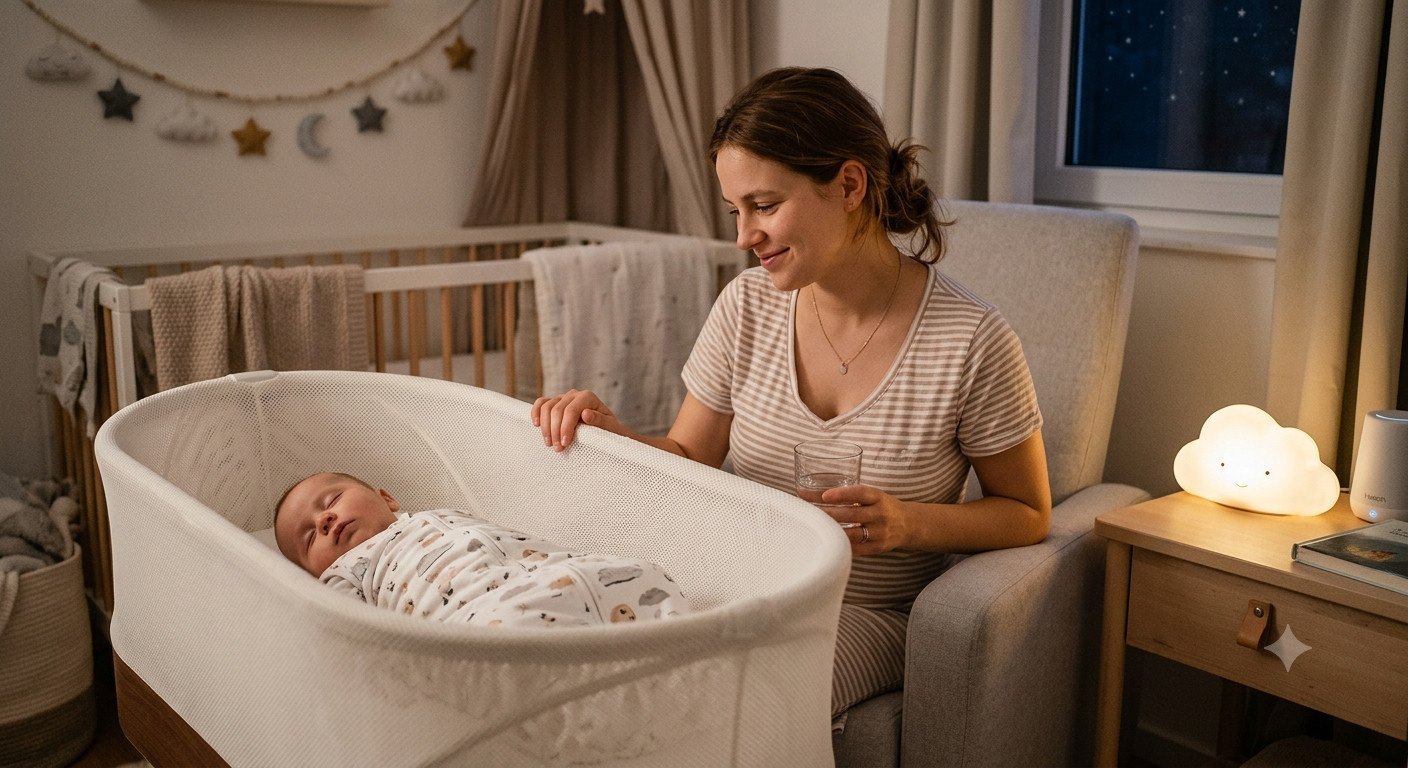
Will your baby really start sleeping through the night – without hours of letting them cry it out? Yes! And here are the 3 steps countless moms have used to get their nights back.
If you landed here, you probably want to know just one thing: how does my baby finally sleep through the night? And ideally, fast.
You're in exactly the right place. My personal take, after digging through a lot of well-meaning but overcomplicated sleep advice, is that the simplest changes tend to be the ones that actually hold up on a real, exhausted night.
Table of Contents
- Why Baby Sleep Is So Complex
- Sleep by Age: What's Actually Normal?
- The Safe Sleep Environment: The Basics
- Step 1: Fixed Times & Dimmed Light
- Step 2: White Noise
- Step 3: The Right Sleep Climate
- The Bedtime Routine: Steps Into a Ritual
- The Luxury Investment When Nothing Else Helps
- Daytime Naps
- Sleep Regressions & Disruptions
- When Nothing Seems to Work
- Frequently Asked Questions
- What You Should Remember
There's this one moment in the first months as a mom when you just can't anymore. When your nights consist of what feels like 100 interruptions, burning eyes become a permanent fixture, and coffee stops working in the morning.
Sleep deprivation isn't a badge you have to wear with pride.
It's an enormous burden on your body, your relationship, and your everyday life.
As moms, we tend to forget ourselves and write off constant waking as "normal." But here's the truth: you're allowed to be tired. You're allowed to miss your old sleep. And above all: you're allowed to make life easier on yourself.
You're allowed to be tired. And above all: you're allowed to make life easier on yourself.
Why Baby Sleep Is So Complex (and Why It's Not Your Fault)
Babies are born with an immature nervous system.
Period.
They can't process the day's stimuli the way we can yet, and often struggle to move from one sleep phase to the next on their own. Gentle sleep aids create a familiar environment that signals safety – without hours of bouncing on an exercise ball.
That's the core of everything that follows: sleep environment + routine = calm nights. What convinces me about framing it this way is that it takes the blame off you as a parent and puts the focus back on things you can actually change.
Sleep by Age: What's Actually Normal?
Before we get to the three steps, it's worth a quick look at what's actually realistic at each age. So many parents doubt themselves even though their baby is behaving completely normally for their age – and comparing notes with the neighbor's baby who apparently "sleeps through" doesn't help.
The first few weeks: chaos is normal
For roughly the first eight to twelve weeks, your baby doesn't have a day-night rhythm yet. Sleep happens in short bursts scattered across day and night, mostly interrupted by hunger. That's not a bad habit you need to train out of them – it's simply biology. The internal clock that tells day apart from night develops gradually. What you can do in this stage: let in plenty of daylight and normal household noise during the day, and start winding down early with dim light in the evening (see Step 1). That helps your baby's body learn the difference between day and night faster – it's not a magic switch for instant sleeping through the night, and at this age, it doesn't need to be.
3 to 6 months: the first patterns emerge
Many babies start showing recognizable patterns in this window: somewhat longer night stretches, three to four naps a day, a hint of predictability. This is also a great stage to start a consistent bedtime routine (more on that below) – your baby is now receptive to repeated rituals. Still, waking to feed overnight remains completely normal for most babies during this stretch.
6 to 12 months: the rhythm settles – mostly
From around six months, many babies are biologically capable of longer stretches of sleep, and naps often consolidate down to two a day. That doesn't automatically mean your baby will now sleep reliably through the night – teething, milestones like crawling or pulling up to stand, and the separation anxiety common at this age can all shake things up again (more on that in the section on sleep regressions below).
Keep in mind: these are rough guidelines, not a checklist your baby has to tick off. The range of what's normal is enormous, and some babies simply need more time than others. If you're ever worried about your child's development or sleep, your pediatrician is always the right person to ask – they know your baby and can tell you what's typical for your specific situation. Honestly, I'm not a fan of the "sleeping through by X weeks" milestone charts that circulate online – they've caused more needless worry in my view than they've ever solved.
The Safe Sleep Environment: The Basics
As much as we all want calmer nights, one thing always comes first: a safe place for your baby to sleep. The points below are general, widely accepted safe-sleep basics as recommended by pediatricians and midwives – for anything specific to your baby, please talk to your pediatrician or midwife, they know your individual situation best. My own view is that this section is worth reading slowly even if you feel like you already know it – it's the one part of this guide I wouldn't want anyone to skim.
The sleep surface
Babies sleep most safely on their backs, on a firm, flat mattress, with a fitted sheet and nothing else in the crib – no loose bedding, bumpers, pillows, blankets, or stuffed animals. As tempting as a beautifully styled, plush nursery looks on Pinterest, when it comes to the actual sleep space, less really is safer. A properly sized sleep sack (see Step 3) reliably replaces loose blankets and can't ride up over your baby's face.
Their own space in your room
For the first several months, it's commonly recommended that babies sleep in their own crib or bassinet in the same room as their parents – close enough for you to respond quickly, but in their own safe sleep space rather than in the adult bed. Exactly how long you do this is a personal decision, and one worth discussing with your midwife or pediatrician.
Where your baby shouldn't sleep unsupervised
Sofas, waterbeds, soft armchairs, and car seats outside the car are not safe places for unsupervised baby sleep – no matter how cozy that after-feed nap on the couch feels in the moment. If you notice yourself nodding off while your baby is lying on you, that's a good cue to gently move them to their own crib rather than fighting your own exhaustion.
Smoke-free air and the right temperature
A smoke-free environment, both during pregnancy and afterward, is another well-established basic of safe baby sleep. We cover room temperature in more detail in Step 3 below.
To swaddle or not to swaddle?
Plenty of parents swear by swaddling in the early weeks – snugly wrapping your baby in a blanket, which can soothe the startle reflex and add a sense of security. A few things matter here: swaddled babies still belong on their backs only, the hips need enough room to move freely, and the moment your baby starts showing signs of trying to roll, swaddling is done – from then on, a sleep sack with free arms takes over. If you're unsure about technique, your midwife can show you how.
None of this replaces individual medical advice. If your baby was born early, had a low birth weight, or has any health considerations, additional recommendations may apply – bring this up directly with your pediatrician.
Step 1: Fixed Times & Dimmed Light
This step costs nothing and still works almost immediately.
- Start every evening at the exact same time
- Dim all the big lights an hour beforehand
- Use only small, warm light sources
Sounds too simple? It's not. Bright overhead light signals "daytime" to the body – and that sabotages the melatonin release your baby needs to fall asleep.
Our Recommendation
The Dimmable Touch Night Light
Provides soft, red light for nighttime diaper changes or nursing, without disrupting the sleep cycle. The easiest first step on this list.
I recommend this one specifically because it's a one-time, low-effort purchase that pairs directly with Step 1 above – no app, no setup, just a warmer light in the room.
Step 2: White Noise
The soundscape in the womb was loud. Really loud.
A steady rushing sound reminds your baby of exactly that – acting almost like a reset button for their nervous system. As a bonus, it reliably blocks out everyday household noise too.
Our Recommendation
The Flexible White Noise Machine
Compact, rechargeable, and ideal for the stroller or on the go – not just for the nursery.
What tips this one over other options for me is the portability – a machine you can only use in one room stops helping the moment you leave the house.
Step 3: The Right Sleep Climate
ROOM TEMPERATURE PLAYS A HUGE ROLE IN SLEEP QUALITY.
The optimal room temperature is 61–64°F (16–18°C). Any warmer, and your baby gets restless without you immediately spotting why.
A proper sleep sack also keeps your baby from overheating, getting cold, or kicking their legs free.
Our Recommendation
The Ergonomic All-Season Sleep Sack
Breathable, temperature-regulating, and prevents dangerous leg-kicking-free – in every season.
I like recommending a single all-season option over separate summer and winter versions – one less thing to think about at 2 a.m. when you're just trying to get your baby dressed for bed.
The Bedtime Routine: Steps Into a Ritual
Light, white noise, sleep climate – each of the three steps above works well on its own. But they get really powerful once you chain them together into a repeating ritual your baby learns to recognize as: sleep is coming next.
Why order matters more than the clock
Babies don't understand clocks yet. What they do learn very well is sequence: if bath time is always followed by dim light, dim light is always followed by the same quiet song, and the song is always followed by the last feed, you've built a chain of cues that tells the nervous system bedtime is near. That reliability of order often matters more than the exact time you start – even though a consistent start time (see Step 1) helps too.
A sample evening ritual
A simple structure you can adapt to your family: a short bath or wash, then lotion and into the sleep sack, then into the dimmed, warmly lit room with white noise on, one last calm feed, maybe a short song or story, then into the crib. Twenty to thirty minutes total is plenty – a marathon routine tends to overwhelm more than it helps.
Putting your baby down drowsy but awake
One detail that can make a real difference: try to put your baby into the crib sleepy but still awake, rather than letting them fall fully asleep in your arms first and then transferring them. That way, they gradually learn to bridge the gap from awake to asleep on their own, without you needing to do anything dramatic. It won't click on night one, and that's fine. As with everything here, small consistent repetition beats perfection. If I had to pick the single most useful habit in this whole guide, it would be this one – simple to describe, but it genuinely takes practice to feel natural.
Consistency over perfection
A routine you actually manage every single night is worth more than a flawless routine that falls apart after three days. Bring your partner into the routine too, so it doesn't rest on one person alone – that takes real pressure off you as well. My honest opinion is that this is the single most overlooked piece of advice in this entire guide, and probably the one worth revisiting if everything else here already feels familiar.
When someone else runs the routine
Ideally, grandparents, a babysitter, or your partner follow the same sequence too – babies often notice the difference between "mom's version" and a completely new order right away. It's worth writing the steps down or walking a caregiver through them before they handle bedtime solo for the first time. After a time change or while traveling, keeping as many elements as possible in place helps too, even if the clock time has to shift.
The Luxury Investment When Nothing Else Helps
When absolutely nothing else helps and sleep deprivation is wearing you down, more and more parents invest in smart technology that automates the entire soothing process.
Our Recommendation
Snoo Smart Sleeper Bassinet
This high-tech bassinet automatically responds to your baby's cries with gentle rocking motions and white noise. It mimics the feeling of the womb and helps both baby and parents get significantly more hours of sleep in a row.
Given the price, I'd only suggest this one after the free and low-cost steps above haven't been enough on their own – it's a genuine investment, not a first move.
Daytime Naps: The Underrated Factor for Nighttime Sleep
One thing that's easy to overlook when you're focused on nighttime sleep: what happens during the day directly shapes what happens at night.
Overtiredness is the secret night-time saboteur
A baby who naps too little or too late during the day isn't automatically easier to get to sleep at night – counterintuitively, it's often the opposite. An overtired nervous system releases stress hormones that make falling asleep harder and the night more restless. Making sure your baby gets enough well-timed daytime sleep isn't indulgence, it's active preparation for a calmer night. This is the piece of the puzzle I see parents skip most often, probably because it feels counterintuitive – more daytime sleep sounding like it should mean less nighttime sleep, when in practice it's usually the reverse.
Wake windows as a rough guide
The younger your baby, the shorter the stretch they can stay happily awake between naps before getting overtired. For newborns, that's often just 45 to 60 minutes; by the second half of the first year, it can stretch to two or three hours. These windows are rough guidelines, not a stopwatch rule – pay more attention to your baby's cues (eye-rubbing, fussiness, that glazed stare) than to the exact minute.
Does every nap need to happen in the crib?
No. Especially in the early months, naps in a carrier, on the go in the stroller, or in your arms are completely fine and make everyday life much more flexible. What matters most is that at least one nap a day – ideally the last one before evening – happens somewhere calm and dim, so the transition into night doesn't feel too abrupt.
The late-afternoon trap
A nap that runs too close to bedtime can push back nighttime tiredness. If your baby regularly naps late and long and then just won't settle in the evening, it's worth gradually shifting that last nap earlier or trimming it a little.
The three-to-two nap transition
Somewhere between six and nine months, the shift from three naps down to two often announces itself: one nap keeps getting shorter, or your baby starts resisting it altogether. That's a normal transition, not a step backward. Give it a week or two of bumpier days, and gradually shift the remaining naps and the bedtime routine a bit earlier if needed, so your baby isn't left with too little total daytime sleep.
Sleep Regressions and Disruptions: Teething, Travel, Illness, Developmental Leaps
Even once you've found a routine that works beautifully, there will be stretches where everything suddenly falls apart again. That's not the exception during the first year – it's the norm.
Common triggers
Teething disrupts plenty of babies' nights, and so do colds, stuffy noses, and growth spurts. Developmental leaps – learning to roll, sit, crawl, or walk – often come with a temporary dip in sleep quality too: your baby's brain is so busy processing something new that it shows up at night as well. Travel, time zone changes, a new nursery, or a visit to grandparents can throw off a familiar setup just as easily.
What actually helps during these stretches
Hold onto the order of your bedtime routine as best you can – it's the anchor that provides security even when things feel stormy, even if exact timing slips a bit. It's completely fine to offer extra closeness, comfort, or a bit more cuddling during a genuinely hard patch – that won't "spoil" your baby or create a bad new habit, as long as you return to your usual routine once the rough patch has passed. My personal take on the "spoiling" worry is that I've never found it a useful lens for a baby this age – comfort during a hard stretch is just comfort, not a habit you're locking in forever.
Don't overhaul the whole system over one bad night
A very human reflex is to question everything the moment one night goes badly: the sleep environment, the routine, your own parenting. Before making bigger changes, it's worth a quick check: is a tooth coming in? Is a new skill about to click? Did you just travel? Often a bumpy stretch explains itself, and sleep settles back down within days to a couple of weeks once the underlying cause passes.
The much-discussed 4-month regression
A phrase that comes up constantly in parenting groups is the "4-month sleep regression." It usually refers to a stretch around four months when a baby's sleep cycles fundamentally mature, which often means more restless nights and more frequent waking for a few weeks. The word "regression" is a bit misleading – it's really a developmental step forward, even though it rarely feels that way at 3 a.m. The same advice applies here: keep the routine steady, breathe, and remember this phase passes.
When Nothing Seems to Work: Getting Help and Being Kind to Yourself
Sometimes you really have tried everything in this article, and sleep still feels like a constant struggle. That doesn't mean you're doing anything wrong.
When to loop in your pediatrician
If your baby breathes noticeably loudly or irregularly, wakes very frequently and is hard to console, shows a noticeable change in feeding or weight, or you simply have a nagging feeling that something isn't right, trust that instinct and talk to your pediatrician or midwife. They can rule out or address medical causes – reflux, intolerances, or other issues – that a routine on its own can't fix.
Sleep consultants as an option
There are professional sleep consultants who specialize in infant sleep and can work through your specific situation with you one-on-one – especially useful if you feel like you've hit a wall on your own. Look for solid, recognized qualifications, and trust your gut about whether their approach fits your parenting style; not every method suits every family.
And go easy on yourself
Exhaustion is not a character flaw, and it's not proof that you're not a good parent. Some babies simply take longer to settle into a rhythm, no matter how consistent you are. If you notice sleep deprivation pushing you to your own limits – physically or emotionally – that's an important signal to ask for support: from your partner, your family, friends, or a professional. You don't have to run like a machine to be a good mom. I mean this as plainly as I can: asking for help here isn't a last resort, it's just a sensible decision, and I'd rather you make it earlier than later.
When exhaustion is more than tiredness
Ongoing sleep deprivation can sometimes overlap with signs of postpartum depression or anxiety – persistent low mood, feeling like you can never switch off, or a hopelessness that goes beyond normal exhaustion. That's not something you have to, or should, handle alone. If this sounds like you, please talk to your OB, midwife, or primary care doctor. Support exists, and the earlier you reach out, the sooner things can get easier.
Frequently Asked Questions
At what age can I start a consistent sleep routine?
You can start with simple, repeated elements like dim evening light in the first weeks of life. A routine your baby actively recognizes usually takes hold around 3 months, but starting earlier certainly doesn't hurt.
Do I have to let my baby cry it out to sleep through the night?
No. The three steps in this article – light, white noise, sleep climate – along with a consistent bedtime routine, help plenty of families without hours of letting their baby cry it out. How much support you offer at bedtime is a personal choice.
How long before a new routine actually works?
Give it one to two weeks of consistent repetition before expecting a noticeable change. Babies need time to link new cues with sleep, and a single rough evening doesn't mean the routine isn't working.
Is it safe for my baby to sleep in a sleep sack?
A properly sized sleep sack is generally considered a safer alternative to loose blankets, since it can't ride up over your baby's face. Make sure it's not too big or too warm for the season, and check with your pediatrician if you're unsure.
By what age should my baby be sleeping through the night?
There's no fixed age that applies to every baby – the range is huge, and waking to feed overnight is normal, especially in the first six months. Talk to your pediatrician if you're unsure whether your baby's pattern falls within a typical range.
Is it okay to run white noise all night long?
Many families run a white noise machine all night without issue. Keep the volume moderate, well below an uncomfortably loud level, and place the device a reasonable distance from your baby's head rather than right next to it.
What can I do about a teething-related sleep regression?
Keep your bedtime routine as stable as you can, offer extra comfort as needed, and talk to your pediatrician or pharmacist about age-appropriate relief options. This phase passes – sleep usually settles back down once the tooth has come through.
When should I see a pediatrician about my baby's sleep?
If you notice unusual breathing sounds, your baby is very hard to console, feeding or weight changes, or your gut just tells you something's off, that's always worth a visit – better to ask one time too many than too few.
How many naps does my baby need a day?
It depends heavily on age: newborns nap in many short bursts throughout the day, while older babies typically settle into three and later two set naps. Follow your baby's tired cues more than a fixed number.
Is it a problem if my baby falls asleep nursing or being held?
No, that's a completely normal and common way to fall asleep, especially in the early months. If it's working for your family, there's no need to change anything. If you'd like more flexibility down the road, gradually introducing other sleep cues like the bedtime routine in this article can help.
What You Should Remember
There's no universal secret recipe that works for every baby at the push of a button – every child is unique.
What does exist: reliable routines and clever tools that noticeably ease the extremely demanding mom life.
You don't have to implement everything at once. Start with just one step – the light routine, for example – and add the rest at your own pace. If you only take one thing from this whole guide, my honest recommendation is to start there – it's free, it's fast, and in my experience it's the step that makes every step after it easier.
You don't have to get through this all alone, and you don't need to justify your exhaustion. Investing in sleep aids that actually work isn't a sign of weakness – it's a decision for your own mental health and your whole family's well-being.
Calm nights aren't a luxury – they're the foundation for a relaxed everyday life with your baby.
Which of the 3 steps is still missing for you? Tell us in the comments – we read every single one.
*Affiliate link. Prices and availability may vary, please check current details with the retailer.
Save on Pinterest →
Comments