Table of Contents
- 1. The psychology of separation: why settling in feels so emotional
- 2. The Berlin Model: the gold standard for settling into daycare
- 3. The best companions for starting daycare
- 4. Tears at goodbye: healthy separation distress vs. real distress
- 5. Signs settling-in is going well – or needs more time
- 6. 7 golden rules for a low-tears transition
- 7. What to tell the caregivers so they really understand your child
- 8. When it gets bumpy: illness, setbacks, and starting over
- 9. Mental load & mom guilt: how to protect yourself
- Frequently Asked Questions
- Bottom line: trust yourself and your child
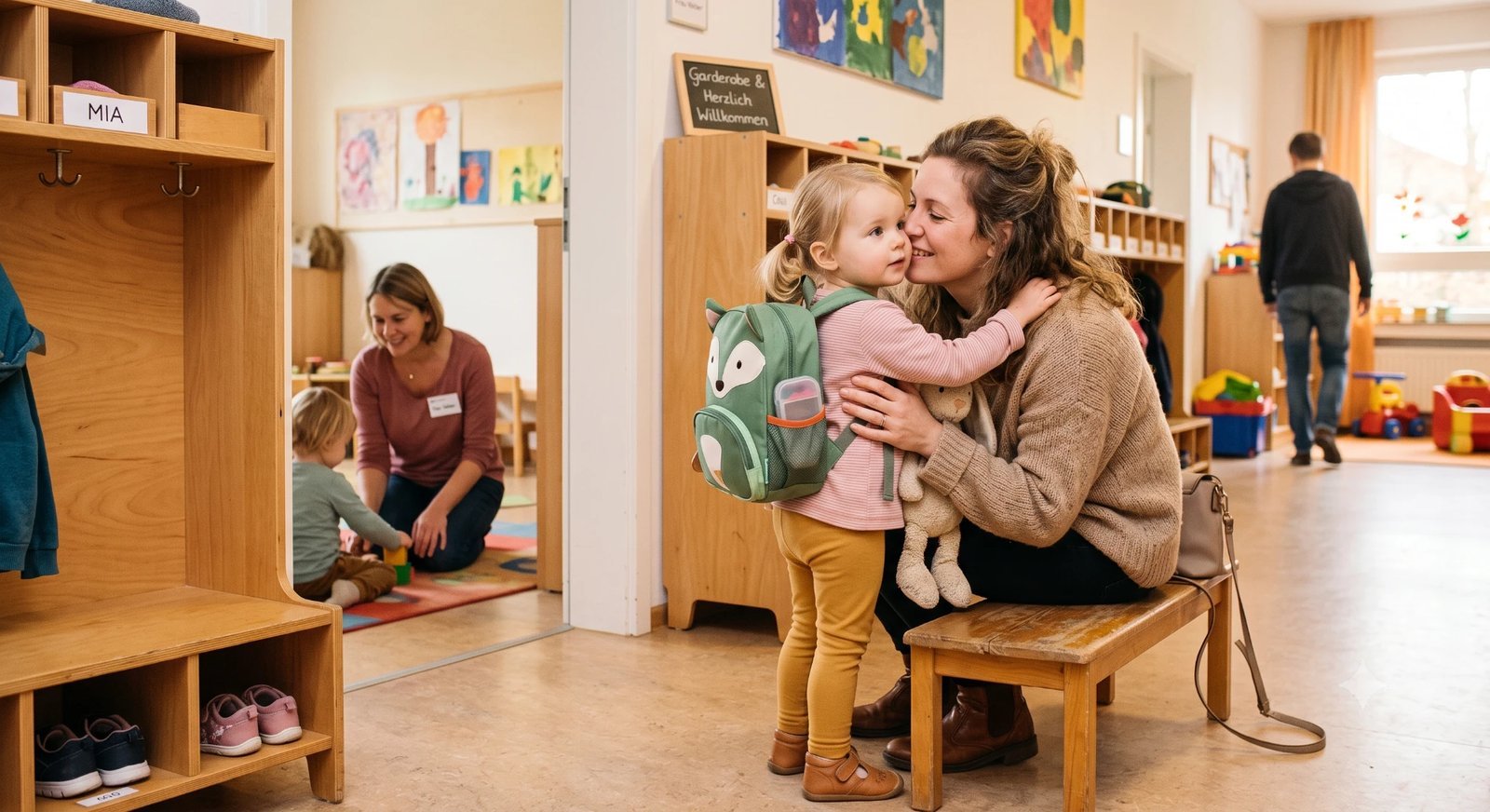
There are moments in a mother's life no real prep course can get you ready for. The day you undress your two-year-old son or your 14-month-old daughter in the daycare cubby area for the very first time definitely belongs on that list. You sit on a bench that's far too small, breathe in that unmistakable daycare smell of crayons, disinfectant, and chamomile tea, and suddenly your throat tightens. While your baby happily plays with the wooden blocks, you silently wonder: "Am I doing the right thing? Is my child really ready? Or, in the end, am I actually the one who isn't ready yet?"
If that's exactly how you're feeling right now, let me tell you one thing first: you are completely normal. What you're feeling isn't a sign of weakness or being overprotective. It's simply attachment. After months of exclusive closeness, waking up together, comforting, and caring, you're handing responsibility for the most precious thing in your life to people who, until recently, were complete strangers to you.
In this in-depth guide, we'll walk through every phase of settling into daycare together. We'll break down the proven Berlin Model step by step, bust the myth of a "tear-free settling-in," talk openly about the emotional weight of mental load for mothers, and give you practical, relationship-focused strategies so this chapter becomes a valuable, strengthening experience for both you and your child.
My personal take, after reading through the research behind this: the Berlin Model is the rare official guideline that actually centers the child's own pace instead of the daycare's timetable, and that's exactly why I keep recommending it to friends who are dreading this step.
1. The psychology of separation: why settling in feels so emotional
Before we look at the practical process, it helps to understand what's happening on a psychological level for both you and your child. John Bowlby's attachment theory shows clearly that young children, up until around age three, need a primary caregiver as a "safe haven." From that haven, they explore the world. As long as the haven is in sight, they dare to move forward. When it suddenly disappears, the biological attachment system sounds the alarm – the child cries, seeks contact, and becomes stressed.
But it's not only the child going through a maturing process. For you as a mom, settling-in is a huge milestone too – it's the first official developmental task of letting go. Many mothers feel an intense mix of emotions during this phase:
- Guilt: "I'm handing my child off just so I can go back to work."
- Loss of control: "Do the caregivers really know he only falls asleep when someone gently strokes his back?"
- Grief: The realization that the baby phase is irreversibly over.
- Relief (and shame about it): The secret joy of two undisturbed hours for a hot cup of coffee.
All of these feelings are allowed to exist. The better you understand and accept your own emotions, the calmer you'll come across to your child. And children have fine antennae: if your child senses that you trust the daycare, the step into that new world becomes far easier for them. What I find most reassuring about this is that it means your own composure isn't just nice to have – it's genuinely one of the most useful things you bring to this whole process.
2. The Berlin Model: the gold standard for settling into daycare
Most German daycare centers and nurseries work according to the so-called Berlin Settling-In Model (developed by the INFANS Institute). This model is scientifically grounded in attachment theory and divides the transition into clear, manageable phases. The goal: the child builds a reliable secondary attachment to their caregiver. I'm genuinely a fan of this model precisely because it doesn't treat separation as a hurdle to clear as fast as possible – it treats it as a relationship that has to be built first, at whatever pace that takes.
Phase 1: The base phase (day 1 to day 3)
For the first three days, one parent (mom or dad) comes into the group together with the child for about 1 to 2 hours. During this time, no separation is attempted.
Your role: You're the "safe haven." You sit passively in the room (ideally on a fixed chair or cushion off to the side), don't push your child to play, but stay reliably present whenever they seek eye contact or run back to you. The key caregiver approaches the child carefully, without being pushy.
Phase 2: The first separation attempt (day 4)
Day four is the key moment. After a short play period, you say a clear goodbye to your child and leave the group room for about 15 to 30 minutes (though you stay in the building).
- Case A (short settling-in indicated): The child is quickly comforted by the caregiver or, after brief distress, turns back to the toys. Settling-in can likely be completed in 2 to 3 weeks.
- Case B (longer settling-in required): The child seems distressed, cries inconsolably, and keeps asking for mom. The separation is ended after a few minutes. Settling-in is planned for around 4 weeks.
Phase 3: The stabilization phase (day 5 to day 10)
Over the following days, separation times are gradually extended. The caregiver takes on more and more care tasks (diaper changes, comforting, feeding), while you step back further and further and eventually leave the building for agreed periods.
Phase 4: The final phase
You're no longer present in the facility but are reachable by phone at all times. Settling-in is considered successful once the child accepts the caregiver as an "accepted source of comfort" – they're allowed to cry at goodbye, but calm down within a few minutes and actively take part in daycare life.
| Phase | Duration | Process & parents' role | Goal |
|---|---|---|---|
| 1. Base phase | Day 1 – 3 | 1–2h together in the room, sitting passively off to the side. No separation. | Child gets to know the environment & caregiver with a trusted person present. |
| 2. Separation attempt | Day 4 (or 5) | Clear goodbye. Leave the room/building for 15–30 min. | Gauge the child's attachment & how they respond. |
| 3. Stabilization | Day 5 – 10+ | Gradually extend separation time (1h to 3h). | Caregiver takes over diaper changes, feeding & comforting entirely. |
| 4. Final phase | From week 3 | Child stays the full planned time (including lunch/nap). | Child reliably lets the caregiver comfort them. |
Important mom tip on the Berlin Model: Don't try to rush the process! Every child has their own pace. A seeming "step back" in week 2 (when the child realizes daycare is now a permanent thing) is completely normal and not a sign of failure.
3. The best companions for starting daycare
Certain everyday helpers have proven their worth in making this transition noticeably easier for your child (and for you). They provide reassurance, build ritual, and make this new chapter feel tangible. Of the many settling-in products out there, these are the three I'd actually spend money on – in my opinion, most of the rest is nice-to-have rather than genuinely useful.
Our Picks for Starting Daycare
A Picture Book to Prepare for Daycare
Picture books show children, weeks before the first day, what to expect through play. They see that other children go through morning routines, circle time, and missing mom too. Reading builds anticipation and takes away the unfamiliarity of the new situation. Personally, this is the first thing I'd buy before a first daycare day – it does more to lower a child's anxiety than almost anything else on this list.
Bento-Style Lunchbox With Compartments
Shared breakfast is a central ritual in daycare life. A bento box with several small compartments is perfect for toddlers: fruit, veggie sticks, nuts, and small bread bites can be kept neat and appealing. Discovering the colorful compartments is fun, gives a positive distraction from homesickness in the first weeks, and encourages independent eating. What convinces me about this one specifically is how much it turns eating into a small game rather than another stressful transition point in the day.
Ergonomic Toddler Backpack With Chest Strap
Having their own backpack is a symbol of "growing up" for kids. What matters for nursery: a built-in chest strap so the straps don't slide off small shoulders, plus enough room for the lunchbox, a change of clothes, and their beloved comfort blanket. I like this pick because the chest strap is the detail most backpacks skip, and it's the difference between a bag that stays put and one dragging at a toddler's shoulders all day.
4. Tears at goodbye: healthy separation distress vs. real distress
No topic causes moms more heartache than their own child crying at goodbye. "Is this painful for my child? Am I traumatizing them?" – these questions shoot through our minds immediately.
A more nuanced look at developmental psychology helps here. Crying is a toddler's natural way of communicating protest and grief. When you leave, your child is saying, through their tears: "I'd rather stay with you, mom!" That's healthy, and it shows a solid attachment. Honestly, I wish more parenting content led with this instead of quietly implying that tears at drop-off mean something has gone wrong.
There is, however, a fundamental difference between healthy separation distress and chronic overwhelm or real distress:
Healthy separation distress
- The child cries hard at goodbye but is comforted by the key caregiver within 2 to 10 minutes.
- Afterward, they turn to playing, other children, or breakfast.
- At pickup, the child seems balanced and shows joy.
Overwhelm & real distress
- The child cries persistently, shrilly, and cannot be calmed by anyone for 20–30 minutes or more.
- They refuse all food and drink, or withdraw completely apathetically into a corner.
- At home, the child shows major behavior changes (sleep problems, constant crying, extreme clinginess).
If the second scenario occurs, settling-in needs to slow down. Talk to the pedagogical staff right away, take a step back in the model, and reduce separation times.
5. Signs settling-in is going well – or needs more time
Tears at goodbye are only one piece of the picture. To really gauge how your child is coping with the new situation, it helps to look at the whole day – and the hours at home afterward. Two children from the same group can react completely differently, and both can be entirely within the normal range. The observations below help you build a sense of how things are going, independent of how other families' timelines look.
Good signs to look for
- Your child eats and drinks at daycare, even if it's less at first than at home.
- Naps work at least somewhat, even if they're shorter or more restless than usual.
- At home, your child mentions small things from daycare (if they're talking yet) – a name, a song, a toy – or acts out daycare scenes in pretend play.
- They seek out other children or their key caregiver again on their own once they've calmed down.
- Evening exhaustion is normal – a new routine takes an enormous amount of energy – but it eases again over the weekend.
When it's worth looking closer
Sometimes settling-in looks unremarkable on the surface, and something still isn't quite right. Watch for these quieter signals:
- Your child seems noticeably different at home than before – persistently irritable, extremely clingy, or unusually withdrawn, for weeks rather than just the first few days.
- Sleep deteriorates in a lasting way, with frequent night waking that goes beyond the usual adjustment period.
- Your child consistently talks about daycare negatively or physically resists in the morning (clinging, screaming, refusing to get dressed) – for weeks, not just on isolated days.
- The key caregiver reports that, even after several weeks, your child is barely comforted or withdraws completely from group activities.
None of these signs on its own means something is wrong – children differ, and some simply need more time. But if several of these add up and persist for weeks, that's your cue to actively bring it up with daycare leadership. Maybe your child needs more time in the stabilization phase, a different key caregiver, or smaller separation steps. That's not a failure on your part or your child's – it's normal fine-tuning of a process that plays out differently for every child. My honest opinion is that this list matters more than the tears themselves – I'd rather a parent track eating, sleeping, and mood over two weeks than fixate on a single hard goodbye.
6. 7 golden rules for a low-tears transition
How can you shape your everyday life to make settling-in as gentle as possible? Here are 7 field-tested tips from experienced moms and caregivers:
- Short, clear goodbye rituals: Don't drag out the goodbye in the cubby area. A long goodbye signals uncertainty to the child: "Is something wrong here?" Better: a big hug, a kiss, the words "I love you, I'm going to work now, and I'll pick you up after nap time!" – then leave promptly.
- Use transitional objects: A comfort cloth, a worn t-shirt from mom, or a favorite stuffed animal work wonders. They carry the familiar scent of home into daycare.
- Be punctual at pickup: Especially in the first weeks, every minute counts for your child. If you've agreed you'll be there after lunch, be there exactly on time. Being late deeply unsettles a child.
- No sneaking off: Never, ever sneak away without saying goodbye just because your child is distracted! This is a major breach of trust. The child learns: "Mom can disappear suddenly at any time," which leads to intense clinginess. Of all seven rules here, this is the one I feel most strongly about – sneaking off might buy you an easier five minutes today, but I think it makes every future goodbye harder.
- Your own battery needs to be full: Don't plan big moves, career pushes, or weaning attempts during the settling-in weeks. Your child needs extra closeness, cuddling, and co-regulation in the afternoons.
- Honest exchange with caregivers: Treat the daycare team as partners. Tell them honestly how the night went, whether the child is teething, or whether they ate poorly in the morning. The more staff know, the better they can respond.
- An unhurried morning routine: Get up 20 minutes earlier during the settling-in phase. A stressful morning full of shouting and rushing carries straight over into your child's mood at daycare drop-off.
7. What to tell the caregivers so they really understand your child
The key caregiver doesn't know your child yet. Everything that's second nature to you at home, she still has to learn from scratch – and the more specific you can be, the sooner she can actually comfort your child instead of just guessing. A short conversation on day one, or a handwritten note, doesn't replace her own observation, but it saves valuable time in exactly the moments your child is most vulnerable.
This information is especially useful to share:
- Comfort rituals: Does your child settle better with stroking, a particular song, being picked up, or distraction with a toy? Every child has their own "instruction manual."
- Sleep habits: Do they need a particular stuffed animal, a specific sleep position, silence, or actually some background noise to fall asleep?
- Eating habits and dislikes: Does your child still use a bottle, prefer eating with their hands, or have foods they flatly refuse?
- Words for basic needs: What word does your child use for needing the bathroom, for "tired," for "hungry"? For children who only have a handful of words so far, this is gold.
- Stress triggers: Is your child sensitive to loud noise, large groups, sudden touch from behind, or specific situations, like several children crying at once?
- Current changes at home: A new sibling, a move, parents living apart, illness in the family – all of this affects how a child handles additional stress, and it's worth letting the caregiver know.
It doesn't need to be a long list, and you don't have to cover every detail in the first conversation – much of it comes up naturally in the first days through quick exchanges at the door. Some families jot down the key points on a note they bring on day one and add to it as new observations come up over the following weeks. What matters most is the mindset behind it: you're not there to check whether everything is being done right, you're giving the caregiver a shortcut to your child. Most caregivers are genuinely grateful for this kind of information, because it lets them comfort your child accurately from the first minute instead of guessing for a while. What I like about this exchange is that it isn't extra work stacked onto your plate – it's ten minutes that saves the caregiver hours of guessing later.
8. When it gets bumpy: illness, setbacks, and starting over
Almost no child makes it through settling-in without at least one cold. That's not a coincidence: a new environment means new germs, close contact with lots of children, and an immune system that's only just learning to fight back. For you as a mom, it's frustrating anyway – especially when you're making good progress in week two and a feverish night throws the whole plan off course.
When illness interrupts the process
After a cold, a stomach bug, or simply more than a week away, it's normal for your child to seem more unsettled again on their return. Deliberately plan a day back together in the group room before the next separation, even if you were already much further along before. That's not a step backward in the settling-in itself – it's a brief refresh of your child's sense of safety, and it usually settles back in within a few days. I'd genuinely encourage that one extra day together rather than jumping straight back into separations – it costs a single day and tends to save you a rough week.
When things suddenly get harder after a good start
Some children start out surprisingly relaxed and then hit a rough patch in week two or three – often right when they realize daycare is now a permanent part of their routine and not just an exciting outing. That's understandable from a developmental standpoint and doesn't mean anything went "wrong" before. Stay especially consistent with your rituals during this phase, talk openly with the daycare team about the setback, and resist the urge to shorten separation times again out of guilt. Holding steady at your last stable point for a day or two before extending further usually helps more than pulling back completely.
One more thing that eases the pressure for a lot of moms: it's not worth comparing your child's settling-in to a colleague's or a close friend's. Some families report a smooth week, others clearly need longer – none of that says anything about your abilities as a mother or about your bond with your child. If settling-in overall takes noticeably longer than planned, say four weeks turning into six or eight, that's not cause for concern. Talk to your employer or revisit your parental leave plans as soon as it becomes clear more time is needed. A realistic time buffer takes an enormous amount of pressure off the situation – for you and for your child, who otherwise picks up on that tension quite clearly.
9. Mental load & mom guilt: how to protect yourself
Beyond organizing spare clothes, diaper packs, and lunchboxes, the mental load often weighs the heaviest. Many mothers feel real burnout during this phase, because society's expectations are sky-high: perform flawlessly at work while also being the most loving, most patient settling-in mom in the world.
Give yourself permission, during these weeks, to let some things slide. Honestly, I'm not a fan of the pressure many parenting circles put on doing settling-in "perfectly" – frozen veggies and a genuinely tired mom on the couch are a completely fine way to get through this phase:
- The house doesn't need to be spotless – frozen veggies and quick pasta dinners are completely fine.
- Share the load with your partner: if possible, dad can take on part of the settling-in process. Studies often show children separate emotionally faster during dad-led settling-in, since the breastfeeding/mom bond doesn't come into play as intensely.
- Build yourself small oases: if your child is alone at daycare for the first 45 minutes, don't sit in the car with your laptop answering emails. Sit on a park bench, drink your favorite coffee, and breathe deeply.
Frequently Asked Questions
How long does settling into daycare usually take?
Under the Berlin Model, plan on 2 to 4 weeks as a rule of thumb. Some children need less time, others considerably more – where possible, build in a buffer of one to two extra weeks so you're not under pressure.
At what age does settling-in make sense?
The Berlin Model is used both for nursery children from around age one and for older preschool-age children. The core principles – time, a reliable "safe haven," gradual separation – apply at any age, though older children often move through the process faster.
Does it have to be mom who handles settling-in?
No. Any close attachment figure can take on settling-in – dad, a grandparent, or another steady caregiver. What matters most is that it's the same person throughout, so your child has a reliable anchor.
What do I do if my child gets sick in the middle of settling-in?
A short interruption is completely normal and not a setback for the whole process. Plan a day back together in the group room once your child has recovered, before resuming separation times, then continue at your own pace.
Is it a bad sign if my child doesn't cry at all?
Not necessarily. Some children are naturally more curious or less clingy and take the change more in stride. In that case, pay attention to other signals instead – eating, sleeping, and behavior at home – rather than judging purely by tears.
What if the bond with the key caregiver just isn't forming?
Bring it up openly and without blame with daycare leadership. Sometimes a bit more time is all it takes; sometimes the chemistry between your child and a particular staff member just isn't there – good facilities are aware of this and will often offer to involve a different caregiver more closely.
How do I support an older sibling while their brother or sister is settling in?
Siblings often pick up on the extra tension at home very precisely and respond with more clinginess or small setbacks of their own. Deliberately set aside short, exclusive moments just for the older child during this time, and explain in simple terms why so much attention is going to the younger sibling right now. That usually helps more, and faster, than you'd expect.
My child still sometimes cries at goodbye even after settling-in is officially done – is that normal?
Yes, that's common and generally nothing to worry about. Even after a successfully completed settling-in, changes in routine – after a vacation, an illness, or a developmental leap – can bring back tears at goodbye now and then. As long as your child is reliably comforted within a few minutes and actively takes part in daycare life, there's no cause for concern.
Bottom line: trust yourself and your child
Settling into daycare is one of the first big hurdles – and opportunities – on your shared journey as mother and child. There will be days when everything goes perfectly, and days when you doubt yourself. That's completely normal.
Always remember: you're not handing your child off to get rid of them – you're giving them a space full of new friendships, new adventures, opportunities to play, and social experiences you simply couldn't offer them at home alone. With plenty of love, patience, and the right knowledge from the Berlin Model, the two of you will master this phase with flying colors! If I could tell every settling-in parent just one thing, it would be this: trust the process even on the days it feels like it isn't working.
*Affiliate link. Prices and availability may vary, please check current details with the retailer.
Save on Pinterest →
Comments