Table of Contents
- The Psychology Behind It: Why Kids Don't Need Perfect Moms
- What Low-Pressure Parenting Actually Means — And What It Isn't
- 4 Perfectionism Myths You Can Drop Today, Guilt-Free
- Lowering the Bar Without the Guilt: Meals, Screens, Mess, and Activities
- The 3-Step Guide to Making It Work in Everyday Life
- Dealing with Outside Pressure: Comparison, Social Media, and Relatives with Opinions
- Letting Go of Optimization: Why Boredom and Empty Time Are Not a Failure
- When Low-Pressure Becomes Its Own Pressure: Signs You're Overcorrecting
- Low-Pressure Parenting as a Team: Staying Aligned as Co-Parents
- Frequently Asked Questions
- Bottom Line: More Mommyluck Through Radical Letting Go
The pressure on moms has probably never been as high as it is today. Scroll through your Instagram or TikTok feed and you'll find flawlessly styled kids' rooms in plain beige, artfully arranged bento boxes for daycare, and moms who apparently meditate at 5:30 a.m. before whipping up a cheerful, healthy breakfast.
This constant show of perfection creates a dangerous sense of never being enough. Anyone trying to meet every parenting trend, every aesthetic, and every social ideal at once is heading straight for parental burnout.
Honestly, this is the part of parenting culture I have the least patience for — it's exhausting to watch, let alone try to live up to. The most effective countermovement to save your nervous system and your family's peace is called low-pressure parenting.
The Psychology Behind It: Why Kids Don't Need Perfect Moms
Developmental psychology has a fundamental concept from British psychoanalyst and pediatrician Donald Winnicott: the "good enough mother."
Winnicott found that children don't need flawless, infallible, or endlessly patient parents to develop in a healthy way. On the contrary: a mother who is human, who has limits, makes mistakes, and is sometimes visibly frustrated prepares her child far more realistically for real life.
What convinces me about this idea is that it puts the pressure in exactly the right place — it doesn't ask you to try less, just to stop faking a control you were never supposed to have in the first place.
- Perfectionism creates performance pressure: when parents always have everything under control, kids unconsciously learn that mistakes are wrong.
- Authenticity builds security: when kids see that mom can be stressed but regulates herself again, they learn important strategies for their own emotional regulation.
- Connection over facade: low-pressure parenting doesn't mean you don't care about your kids. It means shifting the focus from outward appearances back to a real, honest bond.
What Low-Pressure Parenting Actually Means — And What It Isn't
Whenever a parenting approach gets a catchy name, it also gets misread. Low-pressure parenting is sometimes mistaken for permissive parenting, or worse, for simply checking out. Neither is true, and the difference matters.
Low-pressure parenting isn't about lowering your involvement, your warmth, or your attention. It's about lowering the number of things you treat as non-negotiable performance standards. There's a real difference between "I don't care whether my child eats a vegetable at every meal" and "I don't care whether my child eats at all." The first is low-pressure. The second is neglect, and no article about self-compassion should ever be read as license for the second.
- It's not the absence of rules. Kids still need bedtimes, safety rules, and limits on behavior that hurts other people or themselves. Structure and warmth are not the things you're being asked to drop.
- It's not indifference. You still show up, still notice when something is wrong, still ask how their day was. Low-pressure parenting frees up the energy you were spending on appearances so you actually have more left over for the things that matter.
- It's not a free pass to stop trying. It's a filter. You keep trying at the things that genuinely shape your child's wellbeing and development, and you stop trying so hard at the things that mostly shape how your parenting looks to other people.
It also isn't the same as "low-effort" parenting, even though the two sometimes get lumped together. Low-effort parenting is disengagement dressed up as a philosophy – not showing up to things that matter, not learning what's going on in your child's world, not being available when it counts. Low-pressure parenting keeps all of that fully intact. What it drops is the requirement that showing up also has to look effortless, photogenic, or impressive to anyone watching. This is the distinction I find myself repeating most often, because it's the one people misread fastest.
Picture two households on the same street. In the first, evenings are calm because the parents genuinely don't sweat the small stuff – dinner is simple, bedtime has some give in it, nobody's chasing an Instagram-worthy playroom. In the second, evenings are chaotic because nobody's really present, homework goes unchecked, and nobody notices when a child is struggling. Only the first one is low-pressure parenting. The second is a different problem entirely, and no self-compassion framework should ever be stretched to cover it.
A useful way to sort the two apart: does this standard exist because it serves my child, or because it protects me from being judged? If it's the first, keep it. If it's the second, it's a candidate for letting go.
4 Perfectionism Myths You Can Drop Today, Guilt-Free
1. The "Clean Girl" Home
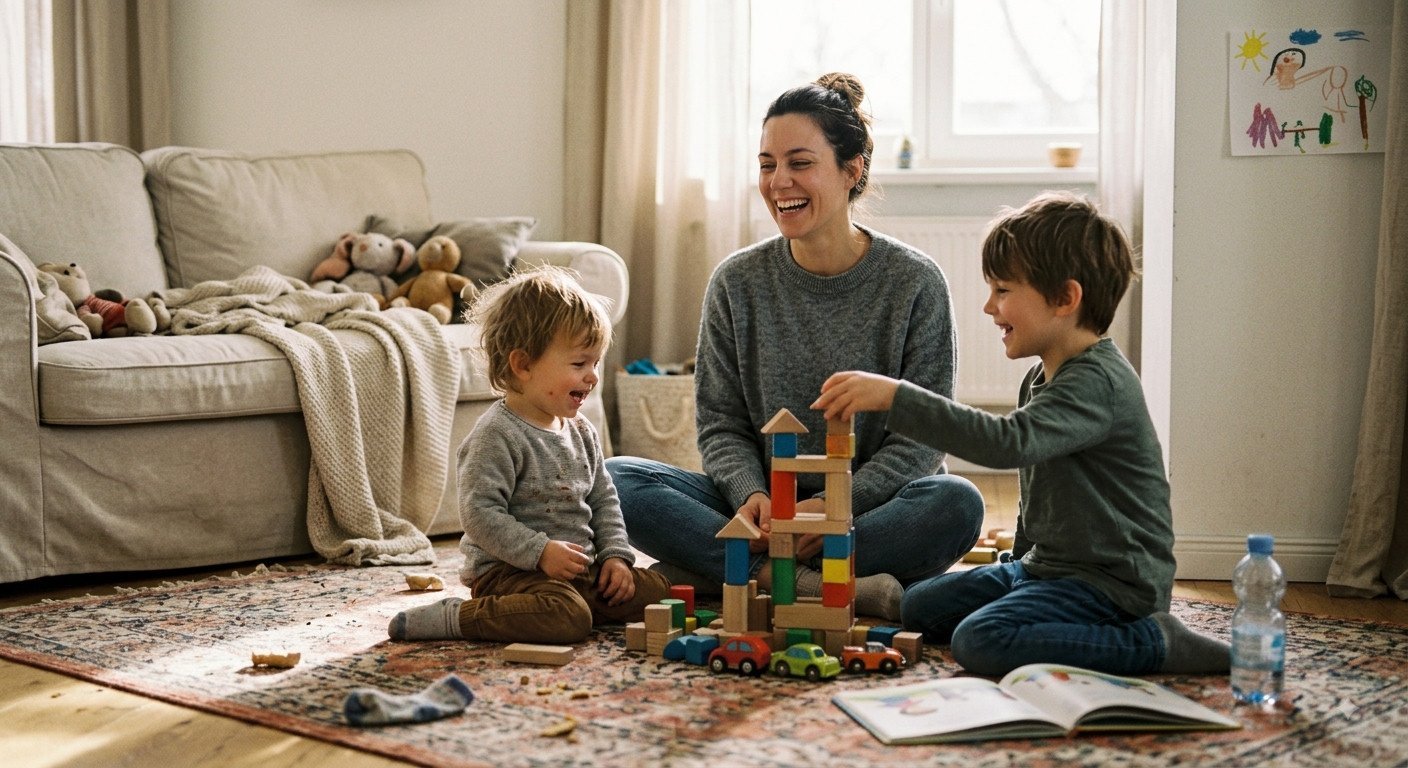
Your living room doesn't need to look like a catalog for Scandinavian designer furniture. Kids play with colorful stuff, leave crumbs, and build forts out of couch cushions. A lively, messy living room isn't a sign of organizational failure – it's the visible sign of a home that's actually being lived in. Personally, this is the myth I find easiest to let go of these days — a lived-in living room has never once impressed me less than a catalog-perfect one.
2. The Visual Five-Star Meal
It's completely fine if dinner is just pasta with butter or a simple cheese sandwich. You don't need to cut cucumbers into heart shapes or artfully arrange veggie plates for your child to get enough nutrients or love. Food should fill you up and taste good – it doesn't need to shine on social media.
3. Nonstop Educational Entertainment
Kids are allowed to be bored. You're not your child's entertainer. Free, unstructured play builds creativity, independence, and problem-solving skills far more than a fifth tightly scheduled enrichment class of the week.
4. The Perfectly Styled Morning Routine
If your morning routine amounts to everyone getting dressed, having something in their stomach, and making it out the door reasonably on time without a meltdown, you've won across the board. Anything else is a bonus.
Lowering the Bar Without the Guilt: Meals, Screens, Mess, and Activities
The myths above cover the mindset. Here's what actually changes on an ordinary Tuesday, area by area.
Meals
Nutrition is a weekly average, not a per-meal report card. A day of toast, pasta, and yogurt followed by a day with more vegetables balances out over the course of a week far better than any single dinner suggests. Keep a short rotation of five or six meals your family actually eats without a fight, and lean on it on the days you have nothing left to give. If your child goes through a stretch of eating basically the same five foods, that's developmentally ordinary and not a sign you're failing at nutrition – it's usually a phase that resolves faster when it isn't treated like a crisis at the table. Kids also learn more about eating from watching what's on your plate over months than from any one artfully arranged dish, so the pressure to make their food look a certain way can be the first thing to go.
Screen Time
Instead of chasing a specific number of minutes, it helps to judge screen time by what it displaces and how your child comes off it. A show that buys you twenty uninterrupted minutes to cook dinner, paired with a child who transitions off it without a meltdown, is doing its job. Predictable windows – after daycare, before dinner, whatever fits your day – tend to cause less friction than an unpredictable "maybe" that gets negotiated fresh every time. You don't owe anyone, including the voice in your own head, a justification for why the show is on; not every use of a screen needs to be defensible as educational to count as a reasonable choice.
Tidiness
A toy box you can toss things into is more sustainable than a system of labeled bins that only you can maintain. Aim for one short reset a day – five or ten minutes, ideally together – rather than a constant background effort to keep everything in its place. Involving your child in that reset doesn't need to become a teaching moment about responsibility every single time; sometimes it's simply faster with two people, and that's reason enough. A cluttered surface at the end of a long day doesn't say anything about your competence as a parent. It says the day was long.
Activities and Enrichment
Before adding another class, it's worth asking whether your child asks to go, or whether you're the one doing the asking on their behalf. One activity attended consistently and happily generally does more for a child than three attended out of a sense that childhood is a checklist to complete. It's also fine to weigh your own capacity – the driving, the cost, the evenings lost to another commitment. Your bandwidth is a legitimate part of the equation, not something to feel guilty about factoring in. An empty Saturday afternoon is not a missed opportunity; for many kids it's the only time all week they get to decide for themselves what to do with their hands and their attention. My honest take: capacity is information, not a weakness to apologize for, and I'd rather use it than override it.
None of these four areas needs to be solved forever. What works when your child is two looks nothing like what works when they're eight, and what gets you through a good week can fall apart during a rough one. The point isn't a permanent setting; it's permission to adjust the bar as often as your family actually needs to.
The 3-Step Guide to Making It Work in Everyday Life
The reframing question in step two is the one I use myself when I catch myself spiraling over something trivial, and it works more often than I'd expect it to.
| Step | Focus | How to Do It |
|---|---|---|
| 1. Halve your expectations | Remove artificial pressure | Cross at least one thing off your to-do list each week that you're only doing to avoid other people's judgment. |
| 2. Filter your priorities | What really matters? | In stressful moments, ask yourself: "Will this still matter in 5 years?" If not, let it go. |
| 3. Practice self-compassion | Move away from guilt | Talk to yourself as lovingly as you'd talk to your best friend if she'd had an exhausting day. |
Dealing with Outside Pressure: Comparison, Social Media, and Relatives with Opinions
Lowering your own standards is only half the work. The other half is holding that line when the people and platforms around you are still running on the old ones.
The Comparison Trap
At pickup, at birthday parties, in the group chat – there's always a parent whose kid seems to be doing more, eating better, sleeping through the night, or reading earlier. What you're comparing is your full, ordinary, unfiltered daily reality against someone else's highlight, whether they mean it that way or not. It also helps to remember that the parent you're comparing yourself to is very likely comparing themselves to somebody else's highlight reel too. Nobody is the standard; everybody is also scrolling. This is especially true for milestones like sleeping through the night or potty training, which tend to be among the most compared and the least within anyone's direct control anyway. Comparison tends to fade when you stop asking "how are we doing compared to them" and start asking "is this actually working for us." Honestly, I think this trap is the hardest one to fully escape, no matter how many times you remind yourself it's a highlight reel and not a full picture.
Curating What You See
Social media doesn't have to be part of your day at all, but if it is, it's worth being deliberate about who's in your feed. Accounts that leave you feeling calmer and more capable are worth keeping. Accounts that reliably leave you feeling behind, no matter how good their content is, are worth muting – you're allowed to do that without any explanation, even to yourself. I'm a genuine believer in this one: you don't owe your feed a reason, and you don't owe yourself one either. The same applies offline: a group chat that leaves you wound up after every message is allowed to get a quieter version of you in it, even if that just means checking it less often.
Well-Meaning Relatives With Opinions
Grandparents, in-laws, and old friends often mean well and are working from a completely different set of norms than the ones you're choosing now. You don't owe every comment a defense of your parenting philosophy. A short, neutral response – "we're doing it differently and it's working for us" – closes most conversations without opening a debate. If a comment keeps coming up from the same person, it can help to name it directly and kindly once, rather than deflecting every time: "I know this is different from how you raised us, and it's the choice we're making – I'd love your support with it." That works whether the comment comes from a parent, a well-meaning friend without kids, or a stranger in the checkout line with opinions about your toddler's meltdown. Said once, calmly, it tends to land better than a dozen small deflections. My own preference is always the short, kind line over the drawn-out defense — it tends to preserve the relationship better than winning the point ever does.
Letting Go of Optimization: Why Boredom and Empty Time Are Not a Failure
There's a quiet assumption running through a lot of modern parenting culture: that every hour of childhood should be doing something for the child – teaching a skill, building a competency, moving them forward. Under that assumption, an afternoon with nothing planned starts to feel like wasted potential.
It isn't, and what I find most convincing about this idea is how often the afternoons with nothing planned turn out to be the ones a child remembers fondly, not the packed ones. Boredom is usually the point right before a child invents something – a game, a fort, a new rule for how the stairs work now. That invention is the skill. It doesn't show up on a schedule and it can't be scheduled into existence; it only shows up in the space left over when nothing else is competing for a child's attention.
A fully booked calendar can look like commitment to a child's development, but it can also mean the child never gets a stretch of time long enough to get bored, get creative, and get absorbed in something of their own choosing. Unstructured time isn't the opposite of a rich childhood. For a lot of kids, it's where the richest parts of childhood actually happen.
There's a related trap worth naming: turning even the unstructured time into something that has to look intentional, like a beautifully arranged loose-parts play tray or a curated basket of activities for a rainy day. There's nothing wrong with any of that if it's genuinely fun to put together, but it isn't required. A pile of pillows and twenty free minutes works just as well, and it costs nothing but time.
Waiting rooms, car rides, and quiet mornings before anyone else is up are part of this too. They don't all need to be filled. A few minutes of genuinely nothing teaches a child how to be with their own thoughts, a skill that gets harder to build the older they get.
It also helps to separate an activity your child loves from a plan for where that activity is supposed to lead. A love of drawing doesn't have to become a portfolio, and a season of soccer doesn't have to become a talent pipeline. Enjoyment is allowed to be the entire point.
When Low-Pressure Becomes Its Own Pressure: Signs You're Overcorrecting
Low-pressure parenting can quietly turn into a new performance if you're not paying attention – a different set of standards to meet, this time about how relaxed you look. It happens gradually and usually with good intentions, which is exactly what makes it hard to notice from the inside. This is the section I'd ask you to read twice, because I think overcorrecting is just as common as the original problem, and much harder to spot from inside it. A few signs it's happened:
- You feel the need to justify a decision to yourself before you've even made it. If choosing the easy dinner comes with an internal defense speech, the pressure hasn't gone anywhere – it's just changed direction.
- You've swapped one guilt for another. Feeling bad about a tidy house is the same mechanism as feeling bad about a messy one. The goal was to feel less judged by your own standards, not to flip which standard you're failing.
- You're skipping things your child genuinely needs, not just things that were only ever for appearances. Routine checkups, consistent bedtimes, or a level of structure your particular child does better with aren't optional extras – they're different from the cosmetic standards this approach is meant to target.
- You measure your relaxation against other parents. Trying to out-low-pressure someone else in the group chat is the comparison trap wearing a new outfit. The point was never to win at being the most relaxed parent in the room.
- "Low-pressure" has become part of how you introduce yourself. If you find yourself explaining your parenting philosophy unprompted, it may be less about your kids and more about needing an identity that feels good right now.
- You avoid things you'd actually enjoy because they don't fit the label. If baking a cake you'd genuinely like to make starts to feel off-limits because "that's not who I am anymore," the philosophy has turned into a new box to stay inside of.
None of this means you're doing it wrong. Checking in with yourself occasionally, not obsessively, just occasionally, is enough. If a rule you dropped is genuinely missed by your child or by you, there's no rule against bringing it back.
Low-Pressure Parenting as a Team: Staying Aligned as Co-Parents
This approach gets harder to hold onto when one parent is fully on board and the other is still operating by the old rules. Mismatched standards between co-parents don't just create friction between the two adults – kids notice quickly which parent to ask when the answer they want is "no" from one and "sure" from the other. If you're parenting solo, the same idea still applies to any grandparent, co-parent in a different household, or regular caregiver who shares in the day-to-day decisions.
It helps to talk through, outside of the heat of an actual moment, which standards each of you actually cares about and why. One of you might feel strongly about screen time and be genuinely relaxed about mess. The other might be the opposite. Neither position is wrong; the goal is knowing where you agree, where you don't, and which of those disagreements are worth a real conversation versus which ones you can each hold loosely.
A short, low-stakes check-in every so often – not a crisis meeting, just five minutes over coffee – tends to work better than trying to resolve every disagreement in the moment it comes up, when everyone is tired and a decision needs to be made right now.
Try to avoid turning the difference into a character judgment. "You're too uptight" or "you never follow through" tends to entrench people rather than move them. It's more useful to name the actual standard in question and ask whether it's serving the kids or serving one parent's comfort. Full agreement isn't actually the goal, and chasing it can create more tension than the original disagreement did – two parents with slightly different comfort levels, who trust each other's judgment and back each other up in front of the kids, function better as a team than two parents forcing themselves into artificial uniformity. In my experience, the couples who do this well aren't the ones who agree on everything — they're the ones who trust each other's judgment enough not to need to. It's also fine for kids to see that the adults in their life don't always agree on every detail and still work it out respectfully; that's its own useful lesson.
Frequently Asked Questions
Does low-pressure parenting mean I don't set rules or boundaries?
No. Kids still need bedtimes, safety limits, and consequences for behavior that hurts others. Low-pressure parenting lowers the cosmetic and performance-based standards, not the structure and boundaries your child actually needs.
Will my child fall behind if I don't sign them up for lots of enrichment activities?
A child who does one or two activities they genuinely enjoy, plus plenty of unstructured time, isn't missing out. What matters more than the number of classes is whether your child has time to play, rest, and follow their own interests.
How do I respond when a relative says I'm too relaxed?
You don't need to win the conversation. A short, calm line like "we're doing it differently and it's working for us" usually closes the topic. Save longer explanations for people who are genuinely asking rather than testing you.
Isn't some pressure necessary to raise disciplined, capable kids?
Structure, consistency, and clear expectations matter, and low-pressure parenting doesn't ask you to drop them. What it asks you to drop is the pressure to look a certain way while doing it – the aesthetic and performance standards that don't actually build discipline or capability.
What if I genuinely enjoy some of the "extra" stuff, like baking an elaborate birthday cake?
Then it's not pressure, it's a preference, and there's nothing to let go of. The point isn't to strip every effort out of parenting; it's to stop doing things purely out of obligation or fear of judgment when they don't bring you or your child any real joy.
How much screen time is actually fine?
Rather than fixating on a specific number, pay attention to what the screen time is displacing and how your child transitions off it. Predictable windows that fit your family's day tend to cause less friction than a constantly renegotiated limit.
Does this still work if my child moves between two households with different rules?
Yes. Kids are generally capable of understanding that different homes work differently, the same way they understand a grandparent's house has different rules than their own. Focus on being consistent and low-pressure within your own household rather than trying to control the other one.
What do I do when trying to be low-pressure makes me feel like I'm not doing enough?
That's usually a sign the pressure has changed shape rather than disappeared. Go back to the core question: does this standard serve my child, or does it mainly protect me from feeling judged? If it's the second, it's fine to let it go, even if letting go still feels uncomfortable at first.
Is low-pressure parenting itself just another trend I'll feel pressure to keep up with?
It can become one if you treat it as an identity to maintain rather than a set of quiet, ordinary choices. The moment it starts requiring proof – a certain vocabulary, visible restraint, a story to tell other parents – it's worth stepping back and just making the next decision on its own terms, label aside.
Bottom Line: More Mommyluck Through Radical Letting Go
Give yourself permission to deliberately lower your expectations. By the end of their childhood, your kids won't remember the neatly folded laundry, the perfectly sorted toy bins, or the aesthetic lunchbox. They'll remember whether their mom was relaxed, approachable, and real.
None of this has to happen overnight, and you don't have to overhaul everything at once. Pick one myth, one everyday friction point, or one outside voice you're ready to stop performing for, and start there. The rest tends to follow at its own pace. If I'm honest, letting go of one of these standards rarely feels like relief on day one — it usually just feels different, and the relief tends to catch up a week or two later.
My personal hope for this piece is that it gives you permission to stop treating your own comfort as the thing you're allowed to sacrifice last. Rewrite your own rules for your family's everyday life today – it brings you more real mommyluck right away. Which perfectionism myth are you dropping first? Tell me in the comments!
Save on Pinterest →
Comments