Table of Contents
- Why the Right Room Setup Makes the Difference
- The 4 Ground Rules for a Working Montessori Kids' Room
- Montessori by Age: What Changes from Baby to Preschooler
- A Long-Lasting Highlight Worth Its Price
- A Walk Through the Room, Zone by Zone
- Smart Additions for a Well-Thought-Out Kids' Room
- Budget-Friendly and DIY Ideas
- Common Mistakes When "Montessori-fying" a Room
- Montessori in a Small Space or a Shared Sibling Room
- Frequently Asked Questions
- Bottom Line: More Independence, Less Toy Chaos
Every mom knows the picture: the kids' room overflows with colorful plastic toys that end up abandoned in a corner after three minutes, and you keep tripping over scattered small parts. Instead of calm and satisfying play, it's often sensory overload – for the child, and for us moms.
My honest take after setting up more than one of these rooms: the Montessori approach isn't an uncomfortable trend – it's a real relief for family life. The principle is: "Help me do it myself." When we set up the kids' room so toddlers can independently reach their toys and safely act on their urge to move, it doesn't just build their confidence. It also gives us moms quiet moments, because the child can sink deeply and contentedly into their play (deep play).
In this guide, we'll walk through what actually makes a Montessori kids' room work: the principles behind it, the different zones in the room, adjustments for each age and stage, budget-friendly options, common pitfalls, and tips for small spaces or shared sibling rooms.
Why the Right Room Setup Makes the Difference
Kids perceive their environment far more intensely than adults. A cluttered environment often leads to frustration, meltdowns, and a short attention span. But when toys are presented clearly and the room allows for movement, play behavior changes completely:
- Independence from the start: the child chooses what to play with on their own, without constantly asking for help.
- Less cleanup frustration: every piece has a fixed spot. Order becomes tangible and understandable for toddlers.
- Targeted movement development: instead of climbing on couches or chairs, the child gets a safe environment for their motor development.
The prepared environment: the heart of the Montessori idea
Maria Montessori talked about the "prepared environment" – a space deliberately built around the child's needs and abilities, rather than adult convenience. The idea is simple: a child who can use their environment independently doesn't need to constantly ask for help – and that "I can do this myself" feeling is exactly what builds confidence and inner calm. In practice, that means furniture, handle heights, and pathways are designed around the child, not the other way around.
Why less choice leads to more focus
A shelf with twenty toys looks like generous variety to us as adults. For a toddler, it's the opposite: too many stimuli at once means jumping from one toy to the next without really settling into anything. Cut the offering down to a manageable selection, and play changes noticeably – kids stay with one thing longer, explore materials calmly, and develop real depth of play. This is the principle I find most convincing in the whole approach, honestly – it runs against instinct, but it works. That's also why toy rotation (see ground rule 2) works so well: less really is more, in the literal sense.
Small details, big impact
A mirror at child height, a coat hook the child can actually reach, a step stool by the sink – details like these seem minor at first glance but make a real difference day to day. They let a child see themselves, dress themselves, wash their own hands. Every time a child manages a task without help, their confidence in their own abilities grows – and that ripples out well beyond the kids' room.
How much freedom actually makes sense?
"Freedom within limits" is one of the core ideas behind the approach – and in practice, often the part parents feel unsure about. Freedom here doesn't mean the child gets to do anything at all; it means that within a clearly defined, safe framework, the child gets to decide for themselves: which toy, for how long, in what order. The limits are still set by the parents – through what goes on the shelf, or through steady cleanup routines. Within that framework, the child gets to genuinely choose – that's the difference between a thoughtful setup and a room where nothing is structured at all.
Why wood and natural materials show up so often in Montessori rooms
Compared to bright plastic, wooden toys and natural materials can look plainer at first glance – but that's often exactly the point. They give a child more sensory feedback through weight, texture, and temperature than smooth, lightweight plastic, and they sit more calmly in a room instead of competing for attention with loud colors. That doesn't make plastic toys off-limits – but given a choice, the Montessori mindset tends to favor materials that offer real sensory feedback and invite a closer look through touch alone. Personally, I wouldn't throw out perfectly good plastic toys just to chase this look — I'd simply lean wood for new purchases going forward.
The 4 Ground Rules for a Working Montessori Kids' Room
Everything at eye level: toys don't belong in cluttered bins – they belong clearly visible on open, low shelves. That way the child can see at a glance what's available, without asking an adult to hand something down. An open shelf at the child's hip height is usually enough – what matters more than expensive furniture is that every toy has its own clearly recognizable spot.
Quality over quantity (toy rotation): offer only 6–8 toys at a time. Store the rest away and swap them out every few weeks. This keeps the selection exciting without overwhelming. A practical side effect: with fewer toys out at once, cleanup gets easier for us as parents too – and a toy that's been resting in the closet feels almost brand new again once it comes back into rotation, even though it's been in the house the whole time.
Room for gross motor skills: kids need to climb, balance, and feel their bodies. A safe climbing zone in the room channels the urge to move – especially on rainy days. Ignore that urge, and it usually finds its own outlet anyway: on the couch, on the dining table, or using open drawers as a makeshift ladder. A dedicated, safe place to climb takes that pressure off.
Create small calm oases: a ground-level reading nook with easily reachable books invites relaxation and a chance to breathe. Especially after an eventful day at daycare, a quiet, soft retreat helps a child wind back down – no screen required, and with the child in charge of what happens there, not an adult.
These four rules work regardless of budget – whether with newly bought furniture or with what's already in the house. What matters isn't the furnishings, it's the principle behind them. If I had to rank them, I'd put toy rotation first — it's the one with the biggest payoff for the least amount of money or effort.
Montessori by Age: What Changes from Baby to Preschooler
A Montessori kids' room isn't a fixed setup you build once and leave untouched for years. It grows with the child – changing in small but meaningful ways at every stage.
0 to 1 year: seeing, reaching, learning to move
In the first year, perception takes center stage. A floor bed or low mattress instead of a crib lets a baby take in the room freely and later push up into crawling or sitting on their own. A low-hanging, child-safe mirror next to the sleeping area gives the baby something interesting to discover without needing to be picked up. Toys at this age need very little variety: a mobile, a grasping toy, a soft ball are plenty. What matters more than quantity is that the baby can move freely on a safe, soft surface.
1 to 3 years: independence takes center stage
Once a child can walk, the focus shifts: now it's about handing over as many small tasks as possible. A coat hook at child height, a low shelf with a few clearly sorted toys, and a dedicated climbing or movement zone become part of the basic setup. Getting dressed becomes relevant too – clothes in a low drawer or on an open rod the child can reach support early attempts at dressing themselves. This is also the stage where the toy rotation from ground rule 2 pays off the most, since toddlers this age are quickly overwhelmed by too many stimuli at once.
3 to 6 years: order, fine motor skills, and first responsibilities
Preschoolers can handle noticeably more complex tasks and increasingly enjoy order and structure. Shelves can now hold a bit more variety, while materials for fine motor skills move to the front: puzzles, sorting games, simple craft supplies in a fixed, reachable spot. A small child-sized desk or craft table becomes interesting now, along with steady routines like putting toys away independently or organizing their own clothes. It's fine for the room to keep growing alongside the child at this stage – for example, swapping the floor bed for a regular kids' bed once the child is ready for it. My personal take is that this stage is where the room becomes genuinely fun to plan together with the child, not just for them.
A Long-Lasting Highlight Worth Its Price
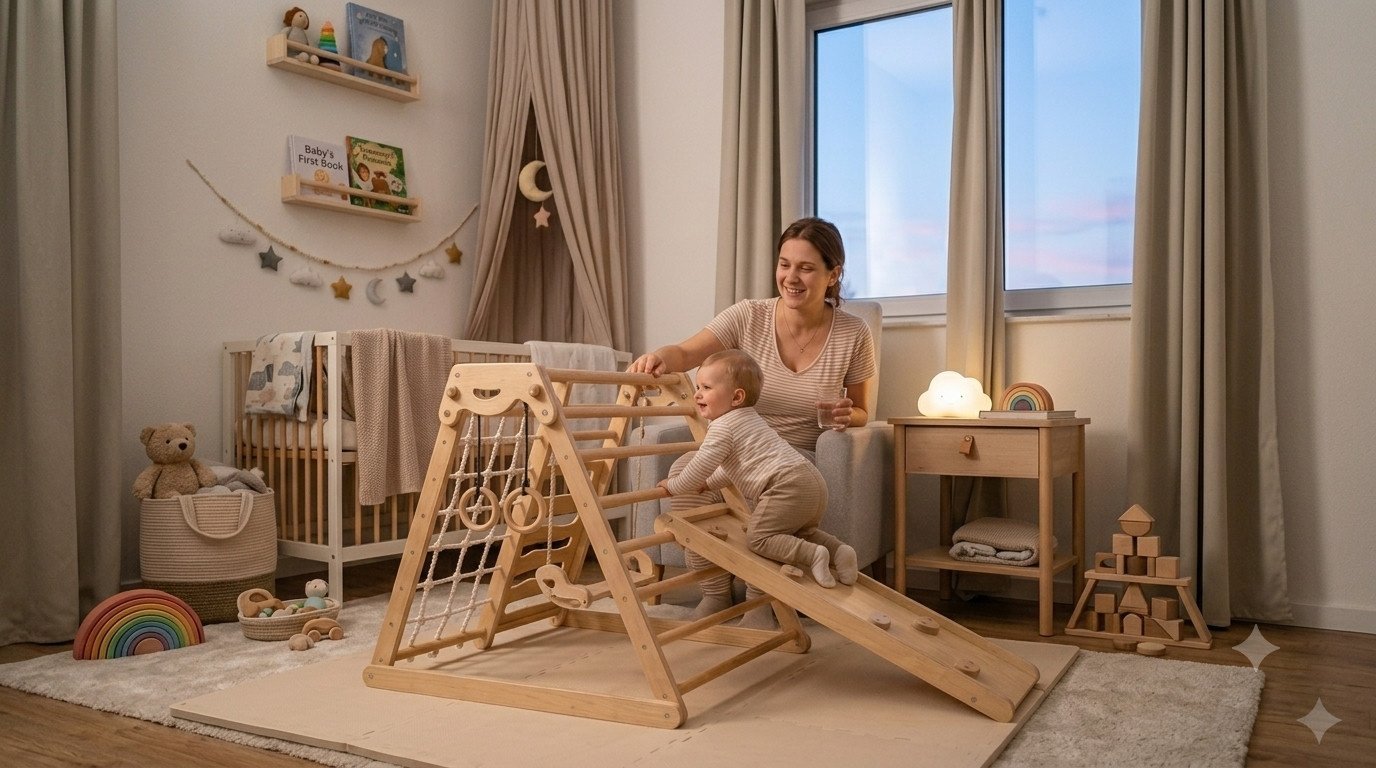
If you want to invest in a thoughtful piece of furniture that gets used for years and noticeably eases everyday life, a high-quality climbing set is a sustainable choice.
This is often the natural starting point for the movement zone we'll look at next: a solid, safe spot for gross motor play that the rest of the room can be organized around.
Our Recommendation
Climbing Triangle Set with Slide & Arch
This solid wood climbing set replaces the playground in your living room. It trains balance, coordination, and self-confidence in a completely safe way. Thanks to its sturdy build, it lasts for years, grows with your child from crawling age into preschool age, and blends timelessly into your living space. It's not a short-lived trend – it's play equipment that gets used intensively, every day.
This is the single piece I'd recommend spending real money on if you only buy one thing from this whole article — it earns its keep daily, for years.
A Walk Through the Room, Zone by Zone
A Montessori kids' room is easiest to plan when you think of it as a set of zones rather than one single space. Each zone serves its own purpose – and doesn't need to be large to work.
The sleep zone
At the center is usually a floor bed or a low mattress. The idea: the child can climb in and out on their own, without needing to be lifted over a crib rail. That might sound unusual at first, but most kids adjust surprisingly quickly in practice, and morning "calling until someone comes" becomes less common, since the child can get up on their own and reach for a picture book, for instance. What convinces me about the floor bed specifically is how small a change it is on paper for how much independence it actually buys.
The movement zone
This is where climbing, balancing, and roughhousing happen – ideally with a soft mat underneath as a cushion. This zone doesn't need to be huge; often a corner of just one or two square meters is enough, as long as it's kept clear for movement and isn't crowded out by extra toys.
Safety check for the movement zone
Before the movement zone goes into use, a quick check is worth it: is the climbing piece on a non-slip surface? Is there a thick enough, soft mat directly underneath and in the immediate surroundings? Are there any furniture edges, outlets, or hard objects in the fall path? Once that safe framework is set up, the child can genuinely play in this zone freely and unsupervised – which is really the whole point.
The play and order zone
This is where the open shelves with the current toy selection live. A clear separation matters here: every material has a fixed spot, so the child can find it again on their own and, ideally, put it back too. A small rug or mat can visually mark off the play area and signals to the child: this is where we play, this is my space.
The dressing zone
A hook at child height for the jacket, a low drawer or open shelf with a few clothing options, a small mirror, and – once the child is ready – a sturdy step stool turn getting dressed in the morning into an increasingly independent task rather than a daily negotiation.
The reading corner
A soft surface, one or two cushions, and a bookshelf the child can choose from independently – that's really all a good reading corner needs. What matters most is that it sits somewhere quiet, away from the movement zone, and that the books face forward, cover out – more on that in a moment.
Storage for the toys currently off rotation
Zone planning also needs a spot that stays out of sight: storage for the toys that aren't on the shelf right now. A cupboard, a bin under the bed, or a closet shelf all work fine. What matters is that the child can't get into it freely – otherwise everything ends up back in the room at once, and the whole point of reducing the selection is lost.
Light and color across the zones
Muted, calm colors on walls and textiles help keep the eye from getting overwhelmed – this makes a noticeable difference in the play and order zone especially. In the reading corner and sleep zone, a warm, dimmable light within the child's reach is also worth having, so the child can decide for themselves when it should be brighter or dimmer. The movement zone, on the other hand, can stay brighter and more inviting – activity is the whole point there.
Smart Additions for a Well-Thought-Out Kids' Room
The following three pieces round out the basic setup nicely: they cover the reading corner, the order zone, and the movement zone alike, and can be bought independently of one another – whichever your room needs most right now. Of the three below, my personal favorite is the front-facing bookshelf — it's the cheapest, and it's the one I've seen change a child's relationship to books the fastest.
Our Recommendations
The Ground-Level Front-Facing Bookshelf
Kids choose books by their cover. This shelf lets them independently grab and put back their own books.
The Open Sorting Shelf
A low wooden shelf so every toy has a clear, fixed spot.
The Foldable Play Mattress
Perfect as a fall cushion under the climbing triangle, or as a cozy reading corner.
Budget-Friendly and DIY Ideas
Not every family wants or needs to buy several new pieces of furniture right away – and that's not necessary. The Montessori idea can be put into practice on a fairly modest budget once you know what actually matters.
Repurpose furniture you already own
A low bookshelf can often be built from an existing shelf simply laid on its side or with its legs shortened. An old kitchen shelf without doors becomes an open toy shelf. A mattress you already have at home can sit directly on the floor as a floor bed instead of inside a bed frame – no extra purchase needed.
Secondhand and local marketplaces
Furniture like shelves or small tables often shows up cheap on local marketplaces or secondhand kids' stores, simply because children outgrow them quickly. For the movement zone, it's worth checking secondhand groups for kids' room equipment, since good-quality wooden pieces often get resold in solid condition. Honestly, I think secondhand is the most underrated option in this entire article — wood holds up so well that used pieces are barely distinguishable from new.
Free changes with a real impact
Some of the most effective changes cost nothing at all: sorting through toys and storing extras out of sight for later rotation. Turning books to face cover-out instead of spine-out on the shelf. Installing a hook within the child's reach instead of hanging the jacket at adult height. These changes cost, at most, a few screws and half an hour – but they change how independently a child can manage their own day.
If you do buy something new
If you want to invest deliberately, it's usually worth putting the money into one durable piece rather than several small extras. A sturdy climbing or movement piece like the set featured above gets used almost daily for years, which pays off differently than short-lived decor items that fall out of fashion – or out of a child's interest – quickly.
Paint and decor on a small budget
A fresh coat of paint in a calm, muted color usually costs little more than a can of paint and a weekend, yet it often changes the feel of a room more than any single new piece of furniture. Homemade decor – a few laminated pictures at the child's eye level, a string with drawings the child can hang up themselves – costs almost nothing and gives the child something to help shape.
Common Mistakes When "Montessori-fying" a Room
A few pitfalls tend to sneak in when redoing a kids' room – and they can quietly undo the effect you're after: more calm, more independence.
Trying to change everything at once
Redoing an entire room in one weekend overwhelms not just the budget but often the child too. Too many new impressions at once work a lot like too many toys: confusing rather than calming. Going step by step – the shelf first, then the climbing zone, then the reading corner – tends to work noticeably better in practice. This is the mistake I'd flag first if a friend asked me for one piece of advice: slow down, the room doesn't need to be finished this weekend.
Leaving too many toys on the shelf
An open, low shelf doesn't do much if twenty toys are still crammed onto it. The calming, orderly effect comes from the deliberate reduction – not from the shelf shape alone. Simply arranging things "more nicely" on the shelf without actually cutting the quantity rarely changes a child's focus or cleanup behavior.
Prioritizing aesthetics over function
Neutral colors and minimalist wooden furniture photograph beautifully – but what matters more than the look is whether the child can actually use the space. A shelf that fits the aesthetic but sits too high or too deep misses the point entirely. When in doubt, reachability for the child wins over a picture-perfect interior every time.
Applying the rules too rigidly
Montessori principles are a guide, not a rulebook set in stone. A favorite stuffed animal that doesn't technically fit the pared-down shelf, or a colorful gift from grandparents, doesn't need to be sorted out immediately. This isn't about perfection – it's about giving the child more independence and a clearer overview overall.
Neglecting safety
More freedom also means more responsibility for securing the space: shelves and climbing furniture need to be anchored to the wall if they could tip, sharp edges should be padded or avoided, and the climbing zone needs enough soft cushioning underneath. More freedom of movement should never come at the cost of safety.
Leaving the child out of the process
A redesigned room tends to work best when the child gets a say in at least some of the small decisions – which books go on the shelf right now, or where the stuffed animal's spot is. A room rearranged entirely over the child's head can end up feeling unfamiliar, even when everything was technically "done right." A child who helped shape their space is also more likely to feel responsible for taking care of it. This is honestly the mistake I'd most want parents to avoid — the design matters far less than whether the child feels any ownership over it.
Montessori in a Small Space or a Shared Sibling Room
Not every family has a spacious, dedicated kids' room – and that's not a dealbreaker either. The core principles work just as well in a few square meters as in a large room; only the execution looks a little different.
Compact, not cramped
In a small space, vertical storage beats horizontal – a narrow but tall-enough shelf instead of a wide one, for instance. Even more important than room size is consistent toy rotation: if only 6–8 toys are out at any time, you only need a small amount of shelf space for them in the first place. Multi-purpose furniture – a floor cushion that doubles as a landing pad, a bed with storage underneath for the toys currently "resting" between rotations – helps make the most of limited square footage too.
When siblings share a room
With different ages in the same room, it helps to separate zones rather than ownership: a shared reading corner, but separate shelves filled individually and set at the right height for each child. The older sibling's shelf can sit a bit higher and hold more variety, while the younger one's stays low and pared-down. That way the room respects both developmental stages without either child feeling shortchanged.
A movement zone without a room of its own
If there's no room left for a climbing element in the kids' room itself, that doesn't mean giving up on it entirely. Many families set up a compact climbing or movement piece in the living room instead – foldable or space-saving models in particular can be put away or moved as needed, so they don't claim a fixed, permanent spot. My take is that a shared living room setup is honestly a fine long-term solution, not just a stopgap until you have more space.
Renter-friendly solutions
Renting doesn't rule out most of these principles – you can implement almost all of them without any structural changes. Instead of drilling hooks or shelves into the wall, sturdy clip-on or adhesive solutions now exist that come off cleanly later. Freestanding shelves and furniture on casters can also simply move with you to the next place, instead of having to plan everything from scratch again.
Frequently Asked Questions
At what age can I start setting up a Montessori kids' room?
Technically from birth – for example with a floor bed and a mirror at the baby's eye level. But you can just as easily start later; the principles adapt to any age, and there's no single "right" moment to begin.
Do I need a floor bed to "do" Montessori?
No. A floor bed is a popular way to implement the idea, but it's not required. What matters is that your child can use their bed as independently as possible – a low kids' bed or a low-profile bed frame achieves the same thing.
How many toys should actually be in the room?
A good rule of thumb is 6–8 toys visible and reachable at once. The rest goes into a bin and gets swapped in every few weeks – see toy rotation above.
Is an expensive climbing triangle necessary, or does an improvised setup work too?
It's not strictly necessary – what matters most is having a safe way to climb and move. A high-quality, durable piece pays off over the long run, but an improvised or secondhand solution serves the same purpose.
How often should I rotate the toys?
There's no fixed schedule. Follow your child's interest: once a toy barely gets touched anymore, it's a good time to swap it out – for most families that works out to roughly every few weeks.
Does this work in a very small room or a shared sibling room?
Yes. Room size matters less than consistently reducing the toys on display and setting up clear zones. In a shared room, separate, age-appropriate shelves help alongside shared spaces like the reading corner.
What do I do with toys that don't fit the concept, like gifts from grandparents?
They don't need to be sorted out right away. Montessori principles are a guide, not a rulebook – a favorite item can keep its spot even if it doesn't perfectly fit the pared-down shelf.
Do I have to give up on a Montessori kids' room if I'm renting?
No. Most adjustments – low shelves, a floor bed, a reduced toy selection – need no structural changes at all. For hooks or light wall elements, clip-on or adhesive solutions that come off cleanly work well.
Do the toys in a Montessori room have to be made of wood?
No, that's not a requirement. Natural materials are favored because they offer more sensory feedback and look calmer in a room, but good-quality plastic toys have their place too. The material matters less than keeping the selection pared-down and clearly presented.
Bottom Line: More Independence, Less Toy Chaos
Setting up a Montessori kids' room doesn't mean replacing the entire room at once. Start small: declutter, put shelves at child height, and create a safe space to move. You'll quickly notice how much calmer and more focused your child plays – and how much more relaxed your own everyday life becomes as a result.
In the end, what matters isn't how many products from this article end up in the room, but whether your child can actually use the space on their own. Whether with newly bought furniture, repurposed secondhand pieces, or a mix of both, every step toward more reachability and less sensory overload pays off in daily life. If I'm honest, my favorite part of this whole approach isn't the tidiness at all — it's watching a child solve something on their own because the room finally lets them.
*Affiliate link. Prices and availability may vary, please check current details with the retailer.
Save on Pinterest →
Comments