Table of Contents
- The psychology of the lunchbox: why food is bonding
- The nutrient formula for mental performance
- The 60-minute meal-prep system for the school week
- The 10 best meal-prep recipes for the bento box
- The ideal tool: the bento lunchbox put to the test
- Strategies for picky eaters
- Nut-free lunchboxes: packing safely
- Staying fresh without a fridge
- Getting kids involved
- Frequently asked questions about school meal prep (FAQ)
- Printable meal-prep shopping list
The alarm goes off at 6:15 a.m. While the coffee maker quietly gurgles, the clock is running out, relentlessly. Getting dressed, checking the backpack, hunting for shoes – and right in the middle of this morning chaos, one daily question looms like a wall: "What do I pack in the lunchbox today that's healthy, fast, and won't come back home untouched?"
For millions of parents, filling the lunchbox each morning is a constant source of everyday stress. It's the daily balancing act between wanting balanced nutrition for your child and the hard reality of picky eating. The problem is rarely a lack of discipline. In my experience running this site and testing lunchbox systems for years, it's almost always a missing routine rather than a missing recipe – once the routine is in place, the rest tends to sort itself out.
With targeted meal prep for school, the morning obstacle course turns into a relaxed three-minute task. This comprehensive guide covers the psychological mechanisms behind kids' eating habits, the biochemical basics for sustained focus in class, and delivers a crystal-clear prep system plus 10 field-tested recipes for the entire school week. My personal take is that most guides skip the psychology and jump straight to recipes – I think that's a mistake, since understanding why a lunchbox gets rejected matters more than any single recipe.
The psychology of the lunchbox: why food is bonding
Before we get into ingredients, cutting techniques, and lunchbox formats, the emotional significance of the lunchbox deserves attention. The classroom is a space full of performance demands, social dynamics, noise, and strict rules. When a child opens their lunchbox in the middle of this bustling morning, far more happens than simple eating.
Developmentally, recess is a sensitive transition. The child leaves the protected frame of the classroom or the focus of a lesson and enters a freer, but often more chaotic, social situation. In that moment, the lunchbox acts as an important security object. The familiar look, the familiar smell, and the careful arrangement signal immediate safety to the nervous system. The lunchbox carries a parent's care directly to the school desk. A lovingly prepared snack is a quiet but powerful signal: I was thinking of you.
A common pitfall in school life is trying to control a child through the lunchbox. When kids feel the box is a tool of parental discipline, they often respond with resistance. Eating becomes a power struggle. Children crave autonomy, and the lunchbox is one of the few areas of the school day they can control themselves. They decide what to eat first, how much to eat, or whether to trade something. When that need for autonomy is respected and the lunchbox is framed as an offer rather than an order, the whole dynamic shifts. Offering choices during prep and accepting leftovers without judgment takes the pressure out of mealtimes. Honestly, I used to fall into this trap myself with the "clean plate" mindset, and letting go of it is what finally made lunch packing feel less like a battle.
Kids also experience food far more through all their senses than adults do. Visual presentation and texture decide acceptance or rejection within seconds. Moisture has to stay separated, since soggy bread instantly loses its appeal. Bite-sized, finger-food-friendly pieces invite casual grabbing while chatting with classmates, while pieces that are too large create a hurdle. Bright colors signal freshness and variety to the brain.
The nutrient formula for mental performance
An energy slump around 10:30 a.m. is the main reason for poor concentration, restlessness, or frustration in class. Kids' blood sugar responds extremely sensitively to what they eat. Standard lunchboxes often consist of refined carbs like white bread with sweet spread, paired with sugary dairy. The result is a rapid blood sugar spike, followed by a big insulin release and the inevitable blood sugar crash.
A well-designed school lunchbox rests on four essential building blocks that provide lasting fullness and steady brain performance:
- Complex carbohydrates: They provide the base for a slow, steady release of glucose to the brain. Whole-grain bread, pumpernickel, oats, whole-grain wraps, or spelt crackers prevent sudden performance dips.
- Quality protein: Building blocks for brain messenger substances, and key for lasting fullness. Cream cheese, quark, hard-boiled eggs, chickpea hummus, cheese cubes, or poultry belong in this category.
- Healthy fats: They support nerve protection and enable the absorption of fat-soluble vitamins. Nuts, seeds, pumpkin seeds, avocado, or a quality oil-based dip cover this need.
- Micronutrients & fiber: A freshness boost that strengthens the immune system and supports gut health. Cucumber slices, bell pepper strips, carrot sticks, berries, apple wedges, and cherry tomatoes form the colorful foundation.
What convinces me about thinking in these four building blocks, rather than in individual "healthy" foods, is that it takes the guesswork out of packing on a rushed morning – you're not asking "is this healthy enough," you're just checking whether the four boxes are ticked.
The 60-minute meal-prep system for the school week
Real meal prep doesn't mean spending hours in the kitchen every day. The secret lies in structured weekly prep. The principle rests on separating preparation (batch prep) from quick morning assembly. I'd rather spend one focused hour on a Sunday than face that same decision fatigue five mornings in a row – that trade-off is, for me, the entire point of this system:
- Sunday power hour (60 minutes): The entire weekly prep block.
- Batch baking (25 minutes): Bake waffles, muffins, or pizza rolls, portion, and freeze – supply for Wednesday through Friday.
- Batch cutting (20 minutes): Prep veggie sticks, dips, and spreads and chill in the bento fresh-box – supply for Monday through Wednesday.
- 3-minute morning assembly: The prepped components just get sorted into the lunchbox in the morning.
The Sunday routine breaks down into one highly efficient hour: the first 25 minutes are all about baking. While the oven preheats, you mix the batter for sugar-free banana-oat waffles, savory spelt pizza rolls, or egg muffins. While the baked goods are in the oven or waffle iron, the cutting-and-dip phase runs from minute 25 to 45. Carrots, kohlrabi, and cucumbers get washed, peeled, and cut into sticks. Line the bottom of the containers with damp paper towel and stand the veggies upright, and they'll stay crisp for up to five days. In parallel, herb quark, hummus, or berry quark go into small, airtight jars. In the last 15 minutes, the baked goods cool completely before being frozen in portions or packed for the first two days.
Four important rules keep everything fresh:
- Baked goods must cool completely before packing to avoid condensation and mold.
- Moist ingredients are separated with lettuce leaves or cream cheese.
- Frozen waffles or pizza rolls can go straight into the box in the morning; they thaw by lunchtime and simultaneously keep neighboring veggies cool.
- Berries should be thoroughly dried after washing to prevent bruising and quick spoiling.
The 10 best meal-prep recipes for the bento box
These ten made the cut after a lot of trial and error in my own kitchen, and I've deliberately kept them freezer- and batch-friendly rather than chasing anything trendy. If I had to pick favorites, the egg muffins and the pizza rolls are the ones that disappear fastest around here.
1. Savory whole-grain pizza rolls
Ingredients: 1 pack spelt yeast dough (or fresh whole-grain dough) · 4 tbsp tomato passata · 1 tsp dried oregano · 100 g grated mozzarella · 50 g turkey ham or diced bell pepper
Instructions:
- Roll out the dough on the counter and spread evenly with the tomato passata.
- Season with oregano and top with turkey ham/pepper and cheese.
- Roll up tightly from the long side and slice into approx. 2 cm thick rounds with a sharp knife.
- Bake at 200°C (390°F) top/bottom heat for 15 to 18 minutes until golden. Freeze individually once cooled.
2. Sugar-free banana-oat waffles
Ingredients: 2 ripe bananas · 2 eggs · 150 g fine oats · 100 ml milk or plant-based drink · 1 tsp baking powder · 1 pinch cinnamon
Instructions:
- Blend all ingredients into a smooth batter.
- Preheat the waffle iron, grease lightly, and bake the batter in batches.
- Let cool and freeze separated by parchment paper. Just toast briefly in the morning if needed.
3. Anti-soggy rainbow wrap
Ingredients: 1 whole-grain tortilla wrap · 2 tbsp cream cheese · 1 large, sturdy lettuce leaf · 2 slices turkey breast or gouda · thinly sliced yellow bell pepper and carrot
Instructions:
- Spread the wrap evenly with cream cheese.
- Lay the lettuce leaf flat on top – it acts as a moisture barrier.
- Add cheese or turkey breast and the veggie strips, roll up tightly, and cut in half at an angle.
4. Colorful egg muffins
Ingredients: 6 eggs · 50 ml milk · 1 handful frozen peas · 1/2 red bell pepper, finely diced · 50 g grated cheese · salt and pepper
Instructions:
- Whisk the eggs with milk, salt, and pepper.
- Distribute veggies and cheese into greased muffin tins.
- Pour the egg mixture over and bake at 180°C (355°F) for approx. 20 minutes until set.
5. Apple-cinnamon overnight oats
Ingredients: 40 g fine oats · 100 ml milk · 2 tbsp plain yogurt · 1/2 grated apple · 1/4 tsp cinnamon
Instructions:
- Combine all ingredients in a small, sealable jar.
- Stir well with a spoon.
- Seal the jar and let it sit in the fridge overnight.
6. Savory cheese-and-veggie skewers
Ingredients: 100 g gouda, whole piece · 8 cherry tomatoes · 1/2 cucumber (sliced) · 8 seedless grapes · wooden skewers with rounded tips
Instructions:
- Cut the cheese into bite-sized cubes.
- Thread cheese, cucumber slices, tomatoes, and grapes onto the skewers, alternating.
- Place directly into a long compartment of the bento box.
7. Crunchy roasted chickpeas
Ingredients: 1 can chickpeas (drained and rinsed) · 1 tbsp olive oil · 1/2 tsp sweet paprika · 1 pinch salt
Instructions:
- After rinsing, pat the chickpeas thoroughly dry with paper towel.
- Toss with olive oil and spices in a bowl.
- Roast on a baking sheet at 190°C (375°F) for approx. 30 minutes until crunchy.
8. Berry quark with crunchy topping
Ingredients: 150 g low-fat quark · 2 tbsp sparkling water · 1 tsp honey or maple syrup · 50 g thawed berries · 2 tbsp oat crunch or granola
Instructions:
- Stir the quark with sparkling water and honey until creamy.
- Fold in the berries gently and spoon the quark into a compartment or small jar.
- Pack the crunchy topping separately and sprinkle on just before eating.
9. Mini spelt pancakes
Ingredients: 100 g spelt flour · 1 egg · 150 ml milk · 1 tsp baking powder · 2 tbsp almond butter for spreading
Instructions:
- Whisk flour, egg, milk, and baking powder into a smooth batter.
- Cook small, tablespoon-sized pancakes in a nonstick pan until golden.
- Spread a little almond butter between two cooled pancakes and press together.
10. The classic layered sandwich
Ingredients: 2 slices whole-grain seeded bread · 1 tbsp butter or cream cheese · 2 slices sliced cheese or turkey breast · 4 thin cucumber slices
Instructions:
- Spread the bread with butter or cream cheese, then top with cheese/turkey and cucumber.
- Place the second slice on top and press down lightly.
- Cut the sandwich into four small squares or triangles with a sharp knife.
The ideal tool: the bento lunchbox put to the test
A well-designed meal-prep system needs the right hardware. Precise separation of ingredients and leak protection come first. This is where a specialized bento lunchbox for kids comes in, covering every need of the school day. My personal take is that this is one area where it's worth spending a bit more upfront – cheap boxes tend to leak or crack within a school year, and replacing one every few months costs more in the end:
| Compartment | Contents |
|---|---|
| Compartment 1 – Complex carbs | 2x mini pizza rolls or 1/2 quartered whole-grain bread slice |
| Compartment 2 – Fruit & micronutrients | Apple wedges (with lemon) or chilled grapes |
| Compartment 3 – Protein | Herb quark dip / hummus or 2x mini egg muffins |
| Compartment 4 – Crunchy extra | Roasted chickpeas / nut mix / spelt crackers |
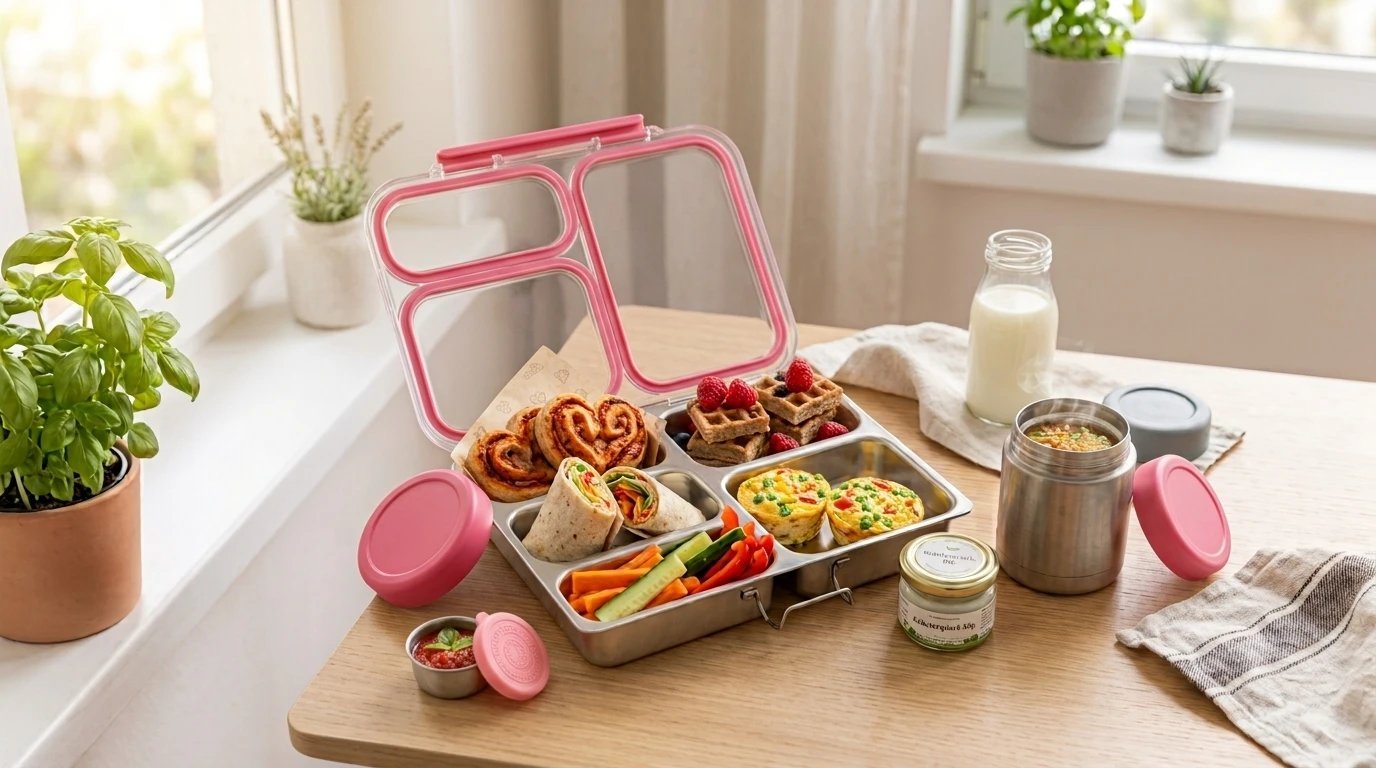
The rigid compartment layout of the bento design guarantees dry baked goods like pizza rolls never touch moist cucumber slices. The lid has a precisely fitted silicone seal that reliably separates each compartment from the others, so thick dips, herb quark, or yogurt travel safely without leaking into neighboring sections.
The closing clips are balanced so kids can operate them effortlessly on their own, which strengthens their sense of autonomy at recess. At the same time, the box stays firmly closed inside the backpack. The stainless steel interior is naturally free of BPA and plasticizers, doesn't hold on to flavors, and cleans up hygienically in the dishwasher after school. A small, separate dip pot keeps sauces or spreads apart from the solid ingredients.
You can round out the setup with a few small extras: cutter sets turn vegetables into fun shapes effortlessly, an insulated stainless steel water bottle keeps water fresh, and small reusable silicone baking molds make freezing and portioning muffins easier.
Our Recommendation
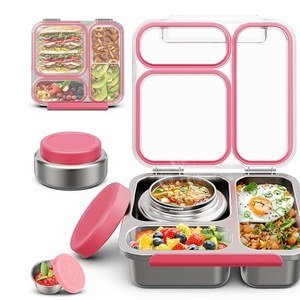
Stainless Steel Bento Lunchbox with Dip Pot
4 leak-proof stainless steel compartments, precisely fitted silicone seal in the lid, extra small dip pot, kid-friendly closing clips, dishwasher-safe. Pink.
What convinces me about this particular box is the combination of a genuinely leak-proof lid and clips a young child can actually open alone – a lot of "kid-friendly" boxes fail on one or the other.
Strategies for picky eaters
If vegetables still get rejected, three psychological steps take the pressure off: starting with the plain ingredient (say, a carrot stick – a high hurdle), moving to a hidden addition (grated carrot baked into bread – unnoticed nutrients), and finally a visual hook (shaped with a cutter – high play value).
Lunchbox design should follow the 80/20 rule: 80 percent of the space goes to familiar favorites, while only 20 percent is reserved for something new or less popular. This reduces overwhelm. Changing the shape of food also changes how kids perceive it: a cucumber slice cut with a cookie cutter has a completely different play value to a child than a plain chunk. Finally, involving your child in shopping and prepping the night before builds their sense of ownership over their own lunchbox. My personal take is that the 80/20 rule is the single most underrated piece of advice in this whole guide; it's simple, it costs nothing, and it works regardless of how picky a particular child is.
With the right mix of preparation, nutrient balance, and functional hardware, the morning lunchbox routine becomes a five-minute task. I say this as someone who used to dread packing lunches – the system genuinely changes how the mornings feel, not just how the lunchbox looks.
Nut-Free Lunchboxes: Packing Safely When Nuts Aren't Allowed at School
Many elementary schools and daycares ban nuts and nut products from lunchboxes entirely, and for good reason: even trace amounts of peanut or hazelnut residue can put a single child with a severe allergy at risk in a shared classroom. For families without an allergy at home, that still means giving the usual ingredient list a second look, since nuts turn up in places you wouldn't expect.
That includes one of the recipes in this guide: the almond butter in the mini spelt pancakes swaps out easily, one-to-one, for sunflower seed butter or pumpkin seed butter, with no change to texture or method. Store-bought granola, trail mix blends, and some chocolate spreads also contain nut or almond traces, so it's worth checking the label before they go anywhere near the lunchbox.
For a crunchy stand-in for the nut category, try:
- Roasted seeds: sunflower seeds, pumpkin seeds, or roasted soybeans give the same crunch and a similar fat quality as nuts.
- Chickpea snacks: the crunchy roasted chickpeas recipe in this guide is naturally nut-free and works well in place of trail mix.
- Seed butters: sunflower seed or pumpkin seed butter taste close enough to almond or peanut butter to use the same way, on bread or as a dip.
- Oat crackers or rice cakes: a good spread base if sesame also needs to be avoided, since some schools restrict that too.
Processed products are worth a closer look too: a "may contain traces of nuts" label is enough to disqualify a snack at many schools, even when nuts don't appear in the ingredient list itself. A quick check of the label before you buy saves an awkward surprise on a school morning. If you're not sure what the rules are at your own school, the answer is usually in the start-of-year parent letter or a quick question to the teacher – and asking once is normally enough for the whole school year.
In households where only one child has a nut allergy, it tends to work better to make the entire lunchbox rotation nut-free rather than running two separate systems in parallel. That simplifies shopping and also prevents the wrong box getting packed by mistake on a rushed morning. Every recipe in this guide except the pancakes is already nut-free as written, so they double as a reliable base for the whole family. Honestly, I'm not a fan of running two parallel grocery lists for one household – it's more room for error, not less, and simplifying almost always wins in my book.
Staying Fresh Without a Fridge: Keeping the Lunchbox Cool Until Lunchtime
Most classrooms don't have a fridge for school bags. The lunchbox often spends three to five hours at room temperature inside the backpack before it's opened – and on a warm late-summer day, or in a classroom that's heated up all morning, that can feel like a lot more. An insulated lunch bag with a small ice pack isn't a nice-to-have here; it's the simplest way to keep the lunchbox noticeably cooler for the whole school morning.
A flat ice pack tucked under or beside the bento box is usually enough to get through the day. A half-frozen water bottle works as an improvised version too: it thaws by lunchtime, keeps the box cool along the way, and doubles as cold water to drink with lunch. The frozen pizza rolls or waffles from the 60-minute system do the same double duty when they go straight from the freezer into the box in the morning.
Not every ingredient holds up equally well without cooling for several hours. As a rule of thumb:
- Fine at room temperature: whole-grain bread, crackers, roasted chickpeas, most fruits and vegetables, and well-sealed waffles or pizza rolls.
- Best transported with an ice pack: cheese, deli meat, quark or yogurt-based preparations, egg muffins, and anything filled with cream cheese.
- Better to skip or swap on hot days: heavy mayonnaise-based dips or very soft dairy products, which lose their texture quickly in the heat.
A double-walled insulated lunch bag holds the temperature noticeably steadier than a thin fabric or paper tote, on top of whatever the ice pack is doing. And if the lunchbox isn't sitting in direct sun but tucked into the backpack among other things, the cold chain stays reasonably steady for the whole morning – with no classroom fridge required. In my experience, the insulated bag is the one purchase in this whole guide that pays for itself the fastest, since it solves the food-safety question with almost zero daily effort.
In the height of summer, or right after a break when classrooms take a while to cool back down, it's worth adding a second ice pack on top of the box rather than just underneath it. In winter, the cooler ambient air usually means one ice pack is plenty. Washing the lunch bag regularly and letting it dry fully also keeps odors from building up in the insulation layer over time.
Getting Kids Involved: Less Waste, More Excitement About Lunch
The most reliable way to find out what a child will actually eat at lunch is refreshingly simple: ask them, and let them help decide. A small "lunchbox bar" during Sunday prep turns the quiet task of filling containers into something the whole family does together, without parents giving up control over the nutrient balance.
The idea: from each of the four bento-box categories (see the table above), set out two or three already-prepped options on the kitchen table. The child then picks, for each day of the week, what goes in which compartment – maybe the cheese-and-veggie skewers instead of the egg muffins on Tuesday, but the apple-cinnamon overnight oats on Wednesday after all. The choice stays inside the prepped, balanced options, so whatever gets picked is still healthy either way – the child is really just deciding on the order and combination.
By early elementary age, kids can often take over filling the compartments themselves entirely, as long as the ingredients are stored within reach in the fridge or in their own designated box. A low drawer or a fridge shelf set aside just for the prepped lunchbox components makes that possible without anyone hunting through the whole fridge on a school morning.
Paying attention to what comes back untouched also gives useful signal for the next Sunday prep session. If the wrap comes home uneaten three weeks running while the pizza rolls disappear every single time, it's worth shifting the balance in the next prep round instead of sticking with the original plan out of habit. Those small adjustments cut down on food waste, and they also show the child that their feedback actually changes something – a sense of having a say that reaches well beyond the lunchbox. What I like most about this feedback loop is that it turns meal prep into something adaptive instead of a fixed rotation you defend out of stubbornness.
Frequently asked questions about school meal prep (FAQ)
How long do prepped veggies stay fresh in the bento box?
If the veggies are cut on Sunday and stored in airtight containers on damp paper towel in the fridge, they stay crisp and fresh for 4 to 5 days.
Can you prep sandwiches or wraps the night before?
Yes, that works fine. Just make sure there's a moisture barrier like cream cheese or a lettuce leaf between the bread/wrap and wet ingredients like tomatoes or cucumbers, so it doesn't get soggy.
How do you keep apple wedges from browning in the box?
A quick dip in cold water with a splash of lemon juice prevents oxidation. Alternatively, cut the apple whole, reassemble it, and secure it with a rubber band.
What foods should you avoid packing in a school bento box?
Strong-smelling foods (like tuna or garlic), foods that melt easily like chocolate, or very liquid soups aren't well suited to standard bento boxes in a school backpack.
What's the best approach for a nut-free school zone?
Instead of nuts, roasted pumpkin seeds, sunflower seeds, chickpea snacks, or oat crunch make crunchy, nutrient-rich alternatives.
How do you avoid cross-contamination when only one sibling has a nut allergy?
The simplest fix is making the whole family's lunchbox rotation nut-free rather than running two separate systems. That way no box gets swapped by mistake on a rushed morning, and shopping stays simple.
Does a single ice pack really hold up in summer?
On especially hot days, or right after a school break, it's worth adding a second ice pack on top of the bag. In winter, cooler ambient air usually means one ice pack is enough.
At what age can kids start packing their own lunchbox?
Once the prepped ingredients are stored within reach, say on their own fridge shelf, many kids can take over filling the compartments largely on their own by early elementary age.
Printable meal-prep shopping list
If there's one thing I'd tell a friend starting this system from scratch, it's to shop from this exact list once before improvising – it removes the decision fatigue of standing in the store trying to remember what the recipes actually need.
Fruit & vegetables
- 2 cucumbers
- 1 kg carrots
- 2 bell peppers (red & yellow)
- 1 bag of apples
- 200 g berries (fresh or frozen)
- 1 punnet cherry tomatoes
- 2 ripe bananas
Refrigerated
- 2 packs cream cheese / quark
- 1 pack sliced cheese (gouda/emmental)
- 1 pack sliced turkey breast
- 1 pack grated mozzarella
- 6 eggs (organic/free-range)
- 1 liter milk or plant-based drink
Pantry & staples
- Fine oats (500 g)
- Spelt flour (type 630 or 1050)
- Whole-grain wraps & whole-grain bread
- 1 can chickpeas
- Tomato passata & oregano
- Nuts / seeds / cinnamon
*Affiliate link. Prices and availability may vary, please check current details with the retailer.
Save on Pinterest →
Comments