Table of Contents
- Part 1: The Psychology of the Load – Why a Heavy Backpack Sabotages the School Day
- Part 2: The Ergonomic Rule of Thumb for Backpack Weight
- Part 3: The 5-Zone Fitting System – Adjust a Backpack Like a Pro
- The Ideal Tool for a Perfect Fit: The Ergobag School Backpack
- Part 4: The Physics of Packing – The Logical 3-Rule System
- Part 5: The Daily "Backpack Check" Ritual for Parents and Kids
- Part 6: A Conflict-Free Daily Routine – Tips for a Strong Backpack Habit
- Part 7: Warning Signs – When the Backpack No Longer Fits (and How to Grow With Your Child)
- Part 8: Care and Maintenance – Making the Backpack Last Through the School Years
- Bottom Line: A Lighter Back, a Clearer Mind
- Frequently Asked Questions About School Backpacks (FAQ)
- Printable Posture Checklist
The first day of school is behind you, and the new backpack is glowing in the brightest colors. But within a few weeks, pride often gives way to concern. The backpack suddenly looks huge on your child, the shoulders round forward, and the walk turns sluggish. Parents watch, worried, as their child's small back curves under the load.
Posture problems, back pain, and tension headaches in school kids aren't a myth – they're real. Many of these issues aren't caused by weight alone, but by a fundamental lack of knowledge about how to fit a school backpack ergonomically and pack it logically. My personal take, after digging through the research on this topic, is that weight gets blamed far too often while fit gets ignored – and fit is usually the easier fix.
The good news: you don't need a medical degree to protect your child's back. This comprehensive guide walks through the psychological and ergonomic basics of a healthy school day. We break down the complex topic of ergonomics into a simple, step-by-step system and show you how to beat the daily backpack chaos with logical rules. What I find genuinely useful about breaking it into zones and rules like this is that it turns a vague worry into a checklist you can actually act on this weekend.
Part 1: The Psychology of the Load – Why a Heavy Backpack Sabotages the School Day
When we talk about backpack weight, we usually focus on the physical effects. But an excessive or poorly distributed load also has serious effects on a child's mental state and ability to learn.
1. Physical stress leads to mental stress
A child's body responds to a too-heavy or poorly fitted backpack with muscle tension. Neck and shoulders tighten up. In psychosomatics, we know that physical pain and tension signal stress to the brain.
If a child arrives at class in the morning with already-aching shoulders, their "mental battery" is already partly drained. The energy needed for focus, attention, and processing lessons gets spent instead on compensating for physical discomfort. An ergonomically optimized backpack is therefore a direct tool for supporting concentration.
2. The feeling of being overwhelmed (autonomy vs. burden)
Psychologically, starting school represents a big step toward autonomy. The child carries their own backpack – a symbol of "I'm a big kid now."
But if the backpack is too heavy or unwieldy, that feeling flips into its opposite. The child feels literally weighed down by these new demands. The backpack stops being a source of pride and becomes a burden. That feeling can unconsciously get projected onto school itself: School is hard, school weighs me down. A light, well-fitting bag, on the other hand, supports a sense of self-efficacy and ease. I find this connection between physical load and how a child feels about school itself is the part most parents never even consider – it changed how I think about backpacks entirely.
3. Sensory overload from a poor fit
Kids process sensory input far more intensely. A backpack that wobbles with every step, whose straps dig in, or that presses on the neck, delivers a constant flood of disruptive signals to a child's nervous system.
The brain tries to filter out these signals, which costs extra energy. A correctly fitted backpack sits snugly against the body, moves with the child, and minimizes this sensory "noise" – leaving more mental capacity for what matters: learning.
Part 2: The Ergonomic Rule of Thumb for Backpack Weight
The question on every parent's mind: how heavy can the backpack be? For a long time, the rigid rule was a maximum of 10 to 12 percent of the child's body weight.
That rule is outdated. Modern posture researchers know that fitness, muscle strength, and above all the fit of the backpack matter more than a raw percentage. A well-trained child with a perfectly fitted 4 kg backpack has fewer problems than an untrained child with a poorly fitted 3 kg backpack. Honestly, I'm not a fan of the old percentage rule at all – it gives parents a false sense of precision about something that's really about fit, not a number on a scale.
The modern benchmark
Still, we need a reference point to avoid overloading: child's body weight × 12% = guideline for the packed backpack.
Example: A child weighs 25 kg (about 55 lbs). The guideline for the full backpack is roughly 3.0 kg / 6.6 lbs (25 × 0.12).
Important: Treat this figure as a warning sign, not a hard rule. If the weight is significantly above it, the contents absolutely need a hard look. If it's below it but your child still complains of pain, the ergonomics (Part 3) need checking instead.
Part 3: The 5-Zone Fitting System – Adjust a Backpack Like a Pro
Even the most expensive ergonomic backpack features are useless if they're not correctly adjusted to your child's body. Fitting is a dynamic process: kids grow, and clothing changes between summer and winter.
Take 15 minutes once to go through this system. After that, a check only takes a minute.
- Zone 1: Back length
- Zone 2: Shoulder straps
- Zone 3: Hip belt
- Zone 4: Chest strap
- Zone 5: Load lifter straps
Zone 1: The core – adjustable back length
Nearly all modern quality backpacks have a back system that grows with the child (often marked S, M, L, or with a scale). This is the first and most important step.
Goal: The backpack needs to support the spine's natural double-S curve. The back panel should sit snugly against the body with no gaps.
Adjustment: Set the system so the top edge of the backpack ends around shoulder height and the bottom edge finishes just above the seat (pelvis level).
Zone 2: The straps – S-shape and padding
Shoulder straps should be wide, well-padded, and curved in an S-shape so they don't dig into the neck.
Goal: Weight is distributed evenly across the shoulders.
Adjustment: Tighten the straps so the backpack sits close to the back.
The two-finger test: You should still be able to comfortably slide two fingers between the strap and the shoulder. Too loose, and the backpack wobbles; too tight, and it cuts off circulation.
Zone 3: The hip belt – the secret weapon for relief
It's often the most underrated element. A good hip belt shifts up to 30–50% of the total weight from the shoulders onto the stable pelvis.
Goal: Shoulder relief and stability.
Adjustment: Close the belt exactly at the level of the hip bones. It should sit firmly but not constrict. The padding should wrap around the hip bones.
Zone 4: The chest strap – freedom for the arms
It connects the two shoulder straps across the chest.
Goal: Keeps the shoulder straps from sliding and away from the armpits, so the child can swing their arms freely while walking, which matters for balance.
Adjustment: Close the strap. It should never press on the neck.
Zone 5: Load lifter straps – fine-tuning the center of gravity
These are the small straps at the top of the shoulder straps that connect the pack body to the harness.
Goal: Bring the backpack's center of gravity as close to the body as possible.
Adjustment: Tighten the straps slightly until the top of the pack sits stably against the upper back. The angle of the straps should be roughly 45 degrees.
The Ideal Tool for a Perfect Fit: The Ergobag School Backpack
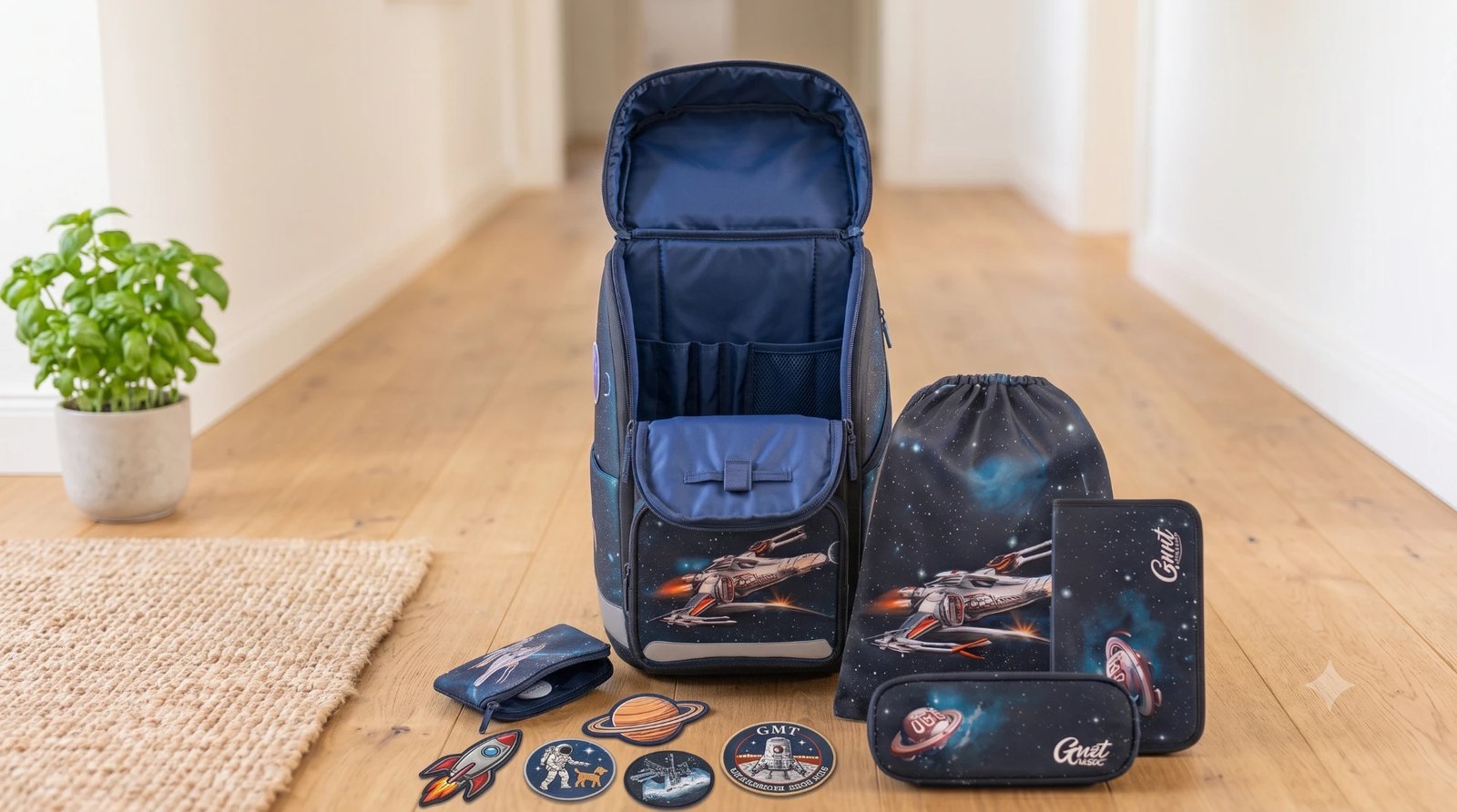
An ergonomic fitting system is useless if the backpack itself doesn't offer a solid foundation. The right hardware matters. To put the 5 zones above into practice effortlessly, Ergobag has been the gold standard among elementary school backpacks for years. My personal take is that a backpack with a genuinely adjustable back system is one of the few school purchases actually worth spending more on, since a cheap one you outgrow in a year usually ends up costing more in the long run.
Why this exact Ergobag backpack matches the ergonomics formula perfectly:
- Stepless "Your-Size System" (Zone 1): The Ergobag has an internal velcro system on the back that lets you adjust the shoulder strap height precisely to your child's height (from 1.00 m to 1.50 m / about 3'3" to 4'11"). The backpack grows perfectly with them across all four elementary school years.
- Wide, padded hip belt with hip fins (Zone 3): Instead of a thin strap, Ergobag uses substantial, padded hip fins. These noticeably shift weight from a child's sensitive shoulders onto the stable hip area.
- Trekking-backpack principle for the back (Zones 2 & 5): The ergonomics are based on the principle of innovative trekking backpacks. Ergonomically shaped S-shoulder straps and adjustable load lifters keep the load close to the body's center of gravity.
- Built-in compression drawstring (Packing Rule 3): The Ergobag has an internal compression drawstring. Pulling it tight draws the contents close to the back so books don't shift around inside.
Our Recommendation
Ergobag School Backpack Set
Stepless "Your-Size System" from 1.00 m to 1.50 m, padded hip belt with hip fins, trekking-backpack principle with S-shoulder straps, built-in compression drawstring.
What convinces me about this particular design is the hip fins – most kids' backpacks in this price range still treat the hip belt as an afterthought, and that's exactly the part doing the most work for shoulder relief.
Part 4: The Physics of Packing – The Logical 3-Rule System
A perfectly fitted backpack is useless if the contents are a chaotic pile. Packing follows physical laws to minimize the lever effect on the spine. What convinces me about thinking of this as physics rather than tidiness is that it gives kids an actual reason to pack a certain way, instead of just being told to "be neater."
Rule 1: Heavy items toward the back (center of gravity)
The backpack's center of gravity should sit as close to the child's body as possible. The further a heavy object sits from the back, the more it pulls the child backward, forcing an unnatural compensating posture (a rounded back).
| Position in the backpack | What goes there? | Why? |
|---|---|---|
| Farthest back (close to the spine) | Heavy books, thick binders, an atlas | Center of gravity stays close to the body. The lever effect is minimal. |
| Middle | Notebooks, pencil case, lightweight materials | Fills out the volume, medium weight. |
| Front / outer pockets | Lunchbox, water bottle, umbrella, keys | Light items, quick access. |
Tip: Use the dedicated heavy-book compartment built into the Ergobag. It holds the heaviest textbooks fixed right against the back panel.
Rule 2: Side-to-side balance (symmetry)
Make sure weight is distributed evenly left and right. Loading one side puts the spine into a sideways curve (a scoliosis risk with sustained load).
- Don't pack heavy items on just one side.
- Use both outer pockets evenly. If the water bottle sits on the left, the umbrella or rain cape should balance it on the right.
Rule 3: Securing the contents (compression)
Contents that shift around inside the backpack change its center of gravity with every step. The child's muscles have to constantly compensate, which is extremely tiring. Use the internal drawstring or side straps to reduce volume and secure the contents.
Part 5: The Daily "Backpack Check" Ritual for Parents and Kids
The ergonomic system falls apart the moment the backpack becomes a dumping ground for unneeded materials. Daily decluttering is the most effective weight prevention there is. If I had to pick just one habit from this entire guide, it would be this two-minute ritual – it costs almost nothing and it's the one thing that actually needs repeating every single day.
The 2-minute evening ritual
Set up a short, consistent evening ritual with your child:
- Empty the backpack: All books, notebooks, and the lunchbox come out.
- Check the schedule: What's actually needed tomorrow? Only that goes back in (following Packing Rules 1 and 2).
- Trash & artwork: Old papers, crumbs, and broken pencils get tossed.
Logical gear hacks to cut weight
- Water bottle: An empty 0.5 L stainless steel bottle weighs far less than a full 1 L plastic one. Kids can often refill at school.
- Pencil case: A fully stocked double pencil case often weighs over 500 g. Does your child really need 36 colored pencils every day? Cut it down to the essential 12.
- Book storage: Ask the school whether heavy books not needed for homework can stay in a classroom cubby. Many schools offer exactly that.
Part 6: A Conflict-Free Daily Routine – Tips for a Strong Backpack Habit
Daily fitting and packing can create friction. Here's how to ease it. My own preference is the "why" explanation over the other two – kids see through empty instructions fast, and an actual reason tends to stick far longer than a rule:
- The "why" explanation: Kids understand logic better than orders. Instead of "You have to close the hip belt," try "When you close this strap here, the backpack rides on your strong hips and your shoulders get a break. Try how light that feels."
- Build ownership: Let your child weigh in during the evening check. "Which book didn't you need today? Should we leave that one out?" Kids who help decide take more ownership and are more likely to keep the ritual going.
- Make ergonomics playful: Turn the 5-zone check into a quick game. "Time for the Formula 1 pit stop. Zone 1: back check? Zone 2: strap check?" Routine becomes ritual.
Part 7: Warning Signs – When the Backpack No Longer Fits (and How to Grow With Your Child)
Even the best-chosen backpack doesn't stay a perfect fit forever. Kids grow in bursts, not steadily, and a backpack that fit perfectly in September can be too small or poorly adjusted by February. It's worth paying attention to the signals your child is already sending you. In my experience this section gets skipped the most, probably because a "set it and forget it" backpack sounds more convenient than it actually is.
Signs worth taking seriously
Some signs are obvious, others creep in slowly and get written off as normal by parents and kids alike. Watch for:
- Red marks or pressure lines on shoulders or hips after taking the backpack off – a clear sign that straps are too tight or padding has stopped cushioning properly.
- Your child leans forward while walking to counterbalance the weight instead of standing upright.
- One-shoulder carrying: if your child starts slinging the backpack over just one shoulder, it's often an unconscious attempt to avoid pressure points on the other side.
- Complaints of tingling or numbness in the arms or hands after the walk to school, which can point to shoulder straps set too tight.
- The backpack visibly sits too low (bottom edge below the seat) or too high (top edge well above the shoulders) – usually a sign the back length (Zone 1) needs readjusting.
- Your child suddenly needs help putting it on when they used to manage fine on their own – a hint that strap lengths or the load no longer match their current build.
None of these signs is cause for alarm. They're an invitation to run through the 5-zone system from Part 3 again – often a small adjustment of a few centimeters is all it takes.
Growth spurts across the elementary school years
Over four years of elementary school, a child's build changes noticeably. Backpacks with a stepless, growing back system – like the Ergobag example above – are built exactly for that, so you don't need to buy a new one every year. Still, build in fixed moments to recheck the fit: the start of the school year, right after summer break (growth spurts often happen during vacation), and whenever you switch between light summer clothing and bulky winter layers, which changes how much slack the straps need.
A simple trick for home: once every six months, measure your child's back length (from the base of the neck to the hips) and compare it with the current setting on the back system. That way you're not relying on guesswork but on an actual reference point.
When a new backpack makes more sense than another adjustment
Every back system eventually runs out of range. If your child reaches the upper end of the stated size range (around 1.50 m / about 4'11" for the model recommended above), the back padding has noticeably thinned, or the straps won't tighten securely anymore no matter how you adjust them, a new backpack is the better investment than a child struggling week after week with a system they've long since outgrown. The same logic applies to a backpack handed down to a younger sibling: a used one is only a good choice if the back padding and adjustment system still perform the way they did on day one.
Part 8: Care and Maintenance – Making the Backpack Last Through the School Years
A well-made ergonomic backpack is an investment, and like any investment, it pays to look after it. A few simple habits keep the gear not just looking good longer, but actually staying ergonomic, instead of gradually losing padding and structure. My personal take is that this part gets skipped most often, since a backpack that still looks fine on the outside doesn't obviously signal that its support has quietly worn out.
Cleaning: what the backpack can handle
Most quality backpacks are made of several parts with different care needs. Check the care label before reaching for detergent or a hose.
- Outer material: usually wipes clean with a damp cloth and mild soap. A soft brush handles stubborn dirt.
- Back padding and straps: avoid fully soaking these where possible. Foam padding absorbs moisture, dries slowly, and can start to smell or lose its spring-back – and with it, its shock absorption.
- Removable inserts: many models have detachable inner pockets, pencil cases, or base plates that are easier to clean separately. Use that to your advantage.
- Drying: always air-dry, ideally standing upright or hung up, never on a radiator or in direct sun – heat can damage adhesives, coatings, and reflective elements.
Keeping an eye on zippers, buckles, and seams
The small mechanical parts of a backpack tend to wear out before the sturdy main fabric does. A quick check fits naturally into the weekly ergonomics ritual from the checklist below:
- Keep zippers running smoothly – a bit of candle wax or pencil graphite on the teeth helps if one starts sticking.
- Check buckles and clips for cracks or a loose mechanism, especially on the hip belt, which gets daily use.
- Watch seams at high-stress points (where straps attach, along the base) – a loose thread caught early can often be repaired; a tear usually can't.
- Get kids in the habit of not overstuffing the backpack and not forcing zippers shut – that's the single most common cause of early wear.
Storing and transporting it properly
Between school days and over breaks, the backpack spends a lot of time in the hallway, the car, or the basement. A few simple rules protect it:
- Don't leave it sitting in a hot car for long stretches – high heat breaks down materials and adhesive bonds.
- Store it on a hook or a stable surface rather than crumpled on the floor, which protects the back padding especially.
- Let a wet backpack (rain, a spilled water bottle) dry out completely before putting it away, to avoid mold forming in the padding and seams.
Reflective panels and safety elements
Many elementary school backpacks come with reflective strips or panels that help with visibility in traffic – an important detail during the darker winter months. These elements are sensitive to harsh cleaning products, heavy scrubbing, or high heat: the reflective coating can dull and lose its effect. Wipe reflective panels gently with a damp cloth only, and check occasionally, say in your car's headlights, whether they still light up noticeably. If the reflectivity has clearly weakened, it's worth adding a separate safety band to the backpack or clothing until a replacement is due.
When has a backpack reached the end of its life?
Not all wear can be fixed. Replace a backpack when the back padding feels noticeably flat and has lost its spring, when straps or buckles no longer hold securely no matter how well cared for, or when load-bearing seams show visible tears. A backpack can still look fine on the outside and have long since lost its ergonomic protection.
Bottom Line: A Lighter Back, a Clearer Mind
A school backpack is far more than a carrying bag. It's an ergonomic tool that, used incorrectly, sabotages health – and used correctly, makes a real contribution to your child's physical and mental fitness. My personal take, after putting this whole guide together, is that fixing the fit matters more than buying a new backpack in nearly every case I've come across.
Start small: pick two ergonomic checks from this list for the coming week and try the evening ritual. You'll be surprised how much lighter your child moves through the school day. If there's one thing I'd want you to remember from all eight parts of this guide, it's that the fit costs nothing and the payoff is immediate – that's why I'd start there before spending a cent on new gear.
Frequently Asked Questions About School Backpacks (FAQ)
What matters more: the backpack's own weight or its fit?
Fit matters far more. A backpack that's 200 g heavier but has a proper hip belt system and back padding relieves the spine more effectively than an ultralight model with no ergonomic support.
How often should I re-fit the school backpack?
Run through the full 5-zone system at least twice a year (at the start of the school year and after winter, when clothing gets thicker or thinner). A quick check of the shoulder straps should happen weekly.
Are rolling backpacks (trolleys) a good alternative?
Posture researchers generally advise against them. Pulling a trolley causes one-sided rotation of the spine. They also often have to be carried up stairs, where their own weight (wheels, telescoping handle) turns into an extreme load.
Are there backpacks that never need adjusting?
No. There are models with more flexible back systems, but the shoulder straps and hip belt always need individual adjustment for body size and clothing.
Do I need to empty the backpack for homework?
Yes, absolutely. Emptying the backpack is the first step in weight prevention. It stops materials from being carried around unused for days at a time.
At what age can my child adjust the backpack correctly on their own?
Most kids need at least occasional help throughout elementary school, especially with the hip belt and back length. If you make the 5-zone system a shared ritual from the start, many children can handle the quick daily check on their own by third or fourth grade. The bigger adjustments – after a growth spurt, for instance – are still worth keeping an eye on yourself.
What if my child refuses to use the hip belt?
Pushing rarely helps. Instead, explain the noticeable difference (see Part 6) and let your child try both ways themselves – walk around the block with the hip belt closed, then open. The feeling in their own body usually convinces kids faster than any explanation. Some just need a bit of time before a closed belt feels normal instead of strange.
Can I just hand the backpack down to a younger sibling?
Generally yes, as long as the material and ergonomics are still in good shape (see Part 8). But treat a hand-me-down backpack like a new one: measure the younger child's back length and reset the system from scratch rather than keeping the old settings. It's also worth checking whether the back padding still has enough spring after years of use.
Why does the backpack weigh noticeably more on some days than others?
That's usually down to the schedule: on days with art, gym, or music, extra items like gym clothes, sports shoes, or a music folder often get added. Look over the schedule together with your child (see the evening check in Part 5) and figure out what genuinely needs to stay in the backpack every day versus what only gets added on specific days.
Printable Posture Checklist
Daily evening check (2 minutes)
- Empty the backpack completely.
- Only pack materials needed tomorrow, per the schedule.
- Toss trash, old papers, and broken pencils.
- Clean the lunchbox and water bottle.
Weekly ergonomics check (1 minute)
- Does the backpack sit centered on the back?
- Does the bottom edge end just above the seat?
- Do the shoulder straps sit snugly (two-finger test)?
- Is the chest strap closed?
- Is the hip belt closed and at hip height?
*Affiliate link. Prices and availability may vary, please check current details with the retailer.
Save on Pinterest →
Comments