Table of Contents
- Why Avoid Certain Foods At All?
- Raw & Insufficiently Heated Meat
- Unpasteurized Dairy & Certain Cheeses
- Raw Fish, Seafood & High-Mercury Fish
- Raw Eggs & Foods Made with Raw Egg
- Deli Meats, Smoked Fish & Pre-Made Salads
- Liver & Vitamin A
- Alcohol – Completely Off-Limits
- Caffeine – It's About the Amount
- Unwashed Fruit, Vegetables & Sprouts
- Overview: Avoid or Fine?
- Eating Out: Restaurants, Buffets & Parties
- Alternatives: What to Enjoy Instead
- Reading Labels: What to Look For When Shopping
- Social Situations: Declining Gracefully
- One Slip-Up and Your Own Peace of Mind
- Frequently Asked Questions
- Making This List Work in Everyday Life
Few pieces of news change your diet as suddenly as a positive pregnancy test. Overnight, every sushi night, every glass of raw milk, and every slice of salami raises the same question: am I even still allowed to eat this?
The short answer: during pregnancy you should mainly avoid raw or insufficiently heated animal products – that includes raw meat, raw fish, unpasteurized dairy, raw eggs, and alcohol. The main concern is two infection risks: listeriosis and toxoplasmosis, both of which can be dangerous for the unborn child. Below you'll find the detailed list of the most important food groups and the reasoning behind each one. I know this list can feel overwhelming the first time you read it – my honest advice is to read it once, save the overview table further down, and not try to memorize every line right away.
Why Avoid Certain Foods At All?
Two pathogens are at the center of food choices during pregnancy:
- Listeria: bacteria that can multiply especially in raw animal products and unpasteurized soft cheese. A listeriosis infection is often mild for the mother, but can have serious consequences for the unborn child.
- Toxoplasmosis pathogens: parasites that can occur in raw or undercooked meat as well as on unwashed fruit and vegetables. A first-time infection during pregnancy can affect the child's development.
Both risks can be significantly reduced through thorough heating, careful washing, and avoiding certain raw products. What I find genuinely useful about understanding the two pathogens behind these rules, rather than just memorizing a list of banned foods, is that it makes the "why" behind each item below much easier to hold onto.
Raw & Insufficiently Heated Meat
Steak tartare, carpaccio, raw salami, and raw ham should come off the menu during pregnancy. Fully cooked meat – heated through to a sufficient core temperature – is fine, though. The same applies to grilled meat: better to double-check that the center is cooked through.
Unpasteurized Dairy & Certain Cheeses
Cheese made from raw (unpasteurized) milk, as well as soft cheese with a washed or white mold rind – such as certain brie or camembert varieties – can contain listeria and should be avoided. Hard cheese and cheese made from pasteurized milk are generally fine. When in doubt, check the label: if it says "made from raw milk" or "au lait cru," it's best to skip it.
Raw Fish, Seafood & High-Mercury Fish
Sushi made with raw fish, oysters, and other raw seafood are also off-limits during pregnancy, again because of the listeria risk. On top of that, Germany's Federal Institute for Risk Assessment (BfR) advises caution with fish species high in mercury, such as tuna, swordfish, and shark, since methylmercury can cross the placenta and affect the child's neurological development. Fatty fish with lower mercury levels, like salmon or mackerel – fully cooked, or smoked and sufficiently heated – provide important omega-3 fatty acids and can stay on the menu in moderation.
Raw Eggs & Foods Made with Raw Egg
Tiramisu, homemade mayonnaise, raw egg in cake batter, or soft-boiled eggs with a runny yolk carry a salmonella risk. Fully cooked eggs – like hard-boiled eggs or scrambled eggs – are fine.
Deli Meats, Smoked Fish & Pre-Made Salads
Cold-smoked fish (like smoked salmon), ready-to-eat cold cuts and deli meats, and pre-made deli salads from the chiller counter also carry an elevated listeria risk, since they're eaten without further heating. Freshly made or thoroughly cooked versions are the safer choice.
Liver & Vitamin A
Liver and liver products (like liver sausage or pâté) contain very high amounts of vitamin A. In excessive amounts, vitamin A can affect the unborn child's development. You should avoid liver entirely during the first trimester; after that, the BfR recommends a limit of about 125 grams per week.
Alcohol – Completely Off-Limits
There is no amount of alcohol considered safe during pregnancy – alcohol passes directly to the child through the placenta and can permanently affect its development. The safest approach is to avoid alcohol entirely throughout the whole pregnancy, including small amounts in sauces or desserts unless they've been fully cooked off.
Caffeine – It's About the Amount
Caffeine doesn't have to be cut out completely during pregnancy, but it should be limited. An amount of up to 200 mg of caffeine per day is considered safe – roughly two cups of filter coffee. Keep in mind that cola, black and green tea, energy drinks, and chocolate all count toward that total.
Unwashed Fruit, Vegetables & Sprouts
Since toxoplasmosis pathogens and other germs can also cling to soil residue on fruit and vegetables, wash everything thoroughly before eating it, including packaged salad. Raw sprouts (like alfalfa or bean sprouts) call for extra caution due to possible bacterial contamination – when in doubt, heat them briefly or skip them entirely.
Overview: Avoid or Fine?
Here's the whole list from this article at a glance, sorted by food group – handy to save or screenshot for a quick check while grocery shopping.
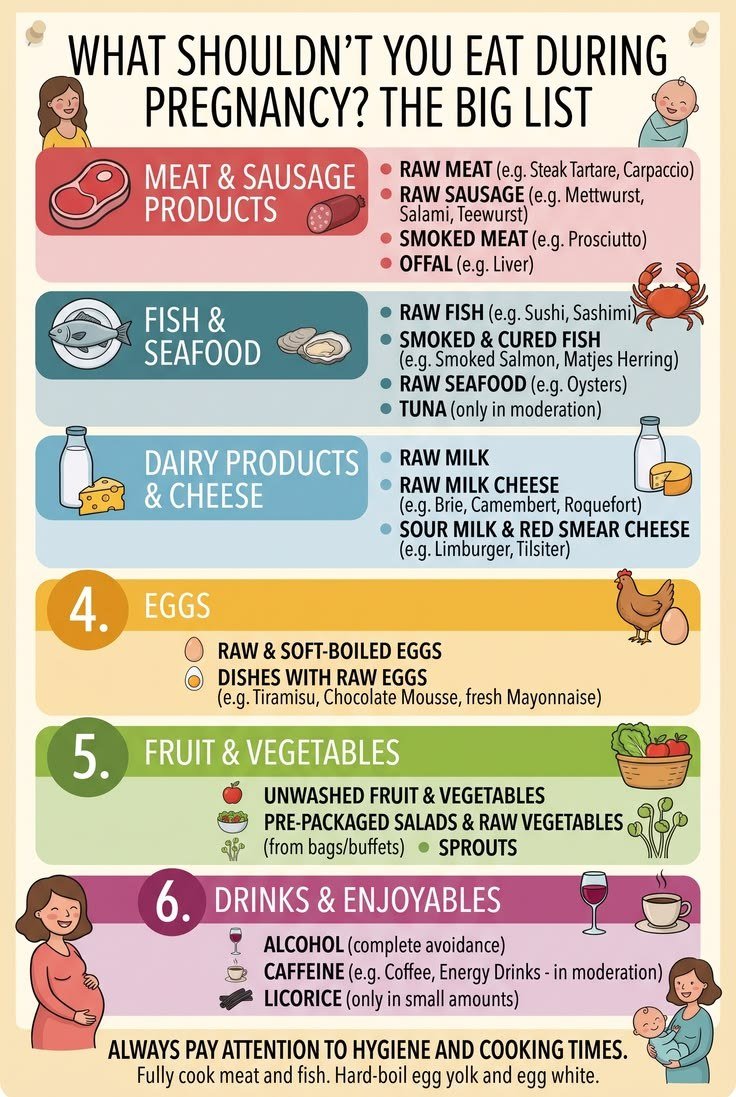
| Food | During Pregnancy | Reason |
|---|---|---|
| Raw meat (steak tartare, carpaccio) | Avoid | Toxoplasmosis risk |
| Unpasteurized cheese, mold-rind soft cheese | Avoid | Listeria risk |
| Raw fish, sushi, raw seafood | Avoid | Listeria risk |
| Tuna, swordfish, shark | Only occasionally, small amounts | High mercury content |
| Raw egg, tiramisu, homemade mayonnaise | Avoid | Salmonella risk |
| Liver & liver products | Avoid in trimester 1, then max 125 g/week | High vitamin A content |
| Alcohol | Avoid completely | No safe amount known |
| Coffee & caffeinated drinks | Max 200 mg caffeine/day | Reaches the child via the placenta |
| Hard-boiled eggs, fully cooked meat/fish | Fine | Pathogens are killed off |
| Hard cheese, pasteurized dairy | Fine | No raw-milk risk |
The table above sums up the essentials. The sections below are meant to help you put this list into practice – when you're eating out, shopping, in social situations, and with a calmer mindset overall, because there's usually a bit of a gap between "I know the rules now" and "this works smoothly at a family dinner too." My personal take is that this gap between knowing the rules and actually living with them day to day is where most of the stress around this topic really comes from, so that's what the rest of this article focuses on.
Eating Out: Restaurants, Buffets & Parties
At home, you're in full control of the ingredient list – out and about, that's trickier. Whether it's the Italian place around the corner, your best friend's wedding, or the office summer party, the same categories from the list above still show up, just dressed up in menu language or tucked under plastic wrap on a buffet table. A few habits make it easier to stay relaxed about it wherever you are. My personal take is that a couple of go-to questions to ask a server or host make a bigger difference here than trying to memorize every menu term in advance.
At Restaurants
For meat dishes, it's worth a quick check on doneness before you order – "medium rare" or "rare" aren't good choices during pregnancy, while "well done" is. The same goes for burger patties, which are often still pink in the middle if undercooked. At Italian restaurants, tartare starters, carpaccio, or antipasto platters with unpasteurized cheese are spots where it's worth asking what exactly is included. Sushi restaurants now almost always offer rolls with cooked egg, cooked shrimp, or plain vegetables – a glance at the menu or a quick question to your server is usually enough to sidestep the raw-fish version. And when it comes to wine or a cocktail with dinner, an alcohol-free alternative is available almost everywhere these days, and no one will think twice about it.
At Buffets and Parties
Buffets are a special case because several of the categories above can show up at once: platters of raw cured meats, smoked salmon bites, soft-cheese antipasto, homemade-mayonnaise-based salads, or a dessert table with tiramisu. A practical approach is to scan the whole buffet before you fill your plate, so you can head straight for the options that work for you – hot dishes, fully cooked meat, fresh vegetables, hard cheese, cooked side dishes. Asking the host or caterer what's in a particular dish is completely normal – most kitchens and hosts are used to that question by now.
Cafés, Bakeries, and On the Go
Even a café display case can occasionally hold items from the list above: tiramisu, certain mousses or cream desserts made with raw egg, and some cakes soaked in liqueur or rum. That's usually noted in the description, and if not, a quick question at the counter clears it up. Classics like cheesecake, crumble cake, or a simple pound cake are typically straightforward, since they're baked all the way through and don't contain raw ingredients of the kind described above.
When Nothing on Offer Fits
Sometimes the options at a buffet or a small café are genuinely limited. For those moments, it helps to keep a small snack on hand – a piece of fruit, some nuts, or a granola bar can tide you over until something suitable turns up. That's not an unusual situation; for a lot of pregnant women, it's just part of what's in the bag these days.
Alternatives: What to Enjoy Instead
A list of things to avoid always reads bigger than it feels at the dinner table. For nearly every category above, there's a version that delivers just as much enjoyment, minus the risk in question. Often it just takes a small tweak in preparation or a different product from the same shelf to keep your favorite dish on the table. A quick reference for when inspiration is running low. I like this table specifically because it reframes the whole topic from "what am I giving up" to "what do I swap in" – for me, that shift makes the whole list feel far less restrictive:
| Instead of … | Try … |
|---|---|
| Steak tartare, carpaccio | a well-done steak, fully cooked beef tenderloin, or a thoroughly cooked burger patty |
| Sushi with raw fish | rolls with cooked egg (tamago), cooked shrimp, or plain vegetables like avocado, cucumber, or sweet potato |
| Unpasteurized cheese, mold-rind soft cheese | hard cheese like gouda, Swiss, or an alpine-style cheese, plus cream cheese and spreadable cheese made from pasteurized milk |
| Tiramisu, homemade mayonnaise | a baked cheesecake, store-bought mayonnaise from the fridge aisle, or scrambled eggs for breakfast |
| Smoked salmon, raw deli meats | fish that's been smoked and sufficiently heated, or freshly sliced meat from a roast cooked all the way through |
| Wine, sparkling wine, beer | alcohol-free sparkling wine, alcohol-free beer, or a homemade mocktail |
| Coffee beyond your daily limit | decaf coffee or a big glass of water with fresh fruit |
Ideas for Weekly Meal Planning
If you're already adjusting your diet, it's worth folding those changes into your regular grocery routine. Instead of grabbing an unpasteurized cheese out of habit, just add a pasteurized version straight to your shopping list so it never ends up tempting you in the fridge. Fully cooked meat or fish freezes well in individual portions, which comes in handy on days when there's little time to cook. And keeping a few alcohol-free drinks stocked in the fridge makes it easier to say yes to a spontaneous invite without a second thought.
Snacks for On the Go
For a quick bite when nothing fresh can be prepared, pre-portioned, fully cooked, or naturally low-risk snacks work well: hard-boiled eggs, cubed hard cheese, whole-grain crackers, peeled fruit, or a homemade sandwich with a fully cooked filling. If you like prepping ahead, you can put together several portions for the week on a quiet evening – one less decision to make on busy days, without having to figure out what fits at every single meal.
Reading Labels: What to Look For When Shopping
At the supermarket or the cheese counter, most of what you need to know is right there on the packaging – you just need to know what to look for. A few habits make grocery shopping noticeably less stressful. Honestly, I think this label-reading skill is the single most useful thing to take from this whole article – once it clicks, checking a package becomes automatic within a few weeks.
Dairy and Cheese
As mentioned earlier, a "made from raw milk" or "au lait cru" label means a cheese isn't a good fit right now. If the packaging says "pasteurized" or "heat-treated" instead, that product has been heated. At a deli counter, it's fine to simply ask the staff if the label doesn't spell it out – that's a routine question for cheese shops and delis, and one they're generally happy to answer.
Fish and Meat Products
For fish, the preparation method on the label is a useful clue: "cold-smoked" means the fish hasn't been sufficiently heated, while "hot-smoked" points to a higher level of heating. For meats and deli products, wording like "ready to eat," "raw," or "cook before eating" gives you a first indication of whether something still needs to go in the pan or can be eaten straight away.
Drinks and Sweets
It's also worth glancing at ingredient lists beyond cheese and fish: chocolates and pralines are sometimes filled with rum or liqueur, usually noted on the packaging as "contains alcohol" or by naming the spirit directly. For coffee, tea, cola, and chocolate, it helps to remember that all of these count toward your daily caffeine total – many drink packaging now lists caffeine content per serving, which makes it easier to add things up over the course of a day.
When in Doubt, Ask or Choose the Safer Option
Not every package is crystal clear, especially loose items from a counter or a farmers' market. When you're unsure, the simplest fix is to just ask, or to reach for the option you're already confident about – hard cheese instead of an unfamiliar variety, for instance. For anything beyond that, your midwife or OB-GYN remains the best person to ask.
Social Situations: Declining Gracefully
Sooner or later, someone will offer you a glass of wine, a slice of unpasteurized cheese, or a spoonful of tiramisu without knowing you're pregnant – or precisely because they forgot. It's never meant unkindly, and you don't need a rehearsed explanation ready to go. My own view is that a short, friendly no is always enough, and you're never obligated to justify it further just because someone seems curious.
Short, Friendly Responses
A simple "Thanks, but I'll pass on that for now" or "Not for me, but it looks great!" covers most situations completely. If you'd like, you can mention you're pregnant – but you don't have to. A lot of moms-to-be settle into their own go-to response over the course of pregnancy and just reach for it whenever it's needed.
If Someone Pushes Back
Some people ask out of genuine curiosity, others out of habit. A brief "It doesn't agree with me right now" or "I'd rather skip it at the moment" usually wraps things up without needing further justification. It's completely fine to leave it there, even if the question comes up again – repetition doesn't mean you owe a longer explanation.
Holidays and Big Family Meals
At Christmas, Easter, or the big family barbecue, several of the categories above can end up on the table at once. It can help to have a rough idea beforehand of what you'll eat that day, or to bring a dish you're already confident about. That keeps the focus on what already works for you – and on most tables, that's more than it might seem at first glance.
At Work and With Colleagues
The same situations pop up at the office: a colleague's birthday cake, a farewell toast, the Friday sushi order for the team. If you haven't shared your pregnancy news yet, these moments are usually easy to navigate quietly – "I already ate" or "I'll stick with water today" rarely raises an eyebrow. Once it's out in the open, it often gets even easier, since colleagues tend to think ahead on their own, setting out an alcohol-free option at the next work event or simply asking what you're avoiding right now.
One Slip-Up and Your Own Peace of Mind
With a list like this, it's completely normal for a bit of worry or even guilt to creep in – especially once you start thinking back over everything you ate in the weeks before. I want to say clearly: that guilt is such a common reaction, and in my view it says nothing at all about how careful or capable a mother-to-be someone is.
Before You Knew You Were Pregnant
Most people find out they're pregnant several weeks after conception. Eating and drinking normally during that window is the rule, not the exception. As mentioned in the FAQ above, a single slip-up usually isn't a reason to panic – it's more of a cue to make more deliberate choices going forward. If you're genuinely worried about something specific you ate, the best move is to talk it through directly with your midwife or OB-GYN – they're best placed to assess your individual situation.
Perfection Isn't the Goal
The list in this article is meant as a guide, not a test you can pass or fail. The point is to meaningfully lower risk in everyday life, not to plan nine months of meals without a single misstep. A café visit where you're not entirely sure the dressing had a trace of unpasteurized cheese in it is a different thing from knowingly and repeatedly ignoring the list. Most moms-to-be settle into a routine after the first few weeks that stops feeling like constant vigilance and just becomes the new normal.
When a Call Is Worth Making
For anything beyond the general guidance in this article – a specific situation, an uneasy feeling after eating, or a question tied to your personal medical history – your midwife or OB-GYN is always the right and most reliable person to ask. A quick call or a question at your next appointment is never too small or too trivial, and no one on your care team will find it an odd thing to ask.
It can also help to talk things over with your partner, a close friend, or other pregnant women going through the same thing. Hearing that other people feel unsure sometimes too, or that they've eaten something not technically on the list, often takes a lot of the weight off. In the end, this list is a tool meant to make everyday life a little safer – not a standard you need to measure yourself against constantly.
Looking Ahead
As pregnancy progresses, working with this list usually starts to feel more natural. What takes a lot of thinking and asking in the early weeks tends to become second nature over time, much like other new routines that come with pregnancy. Nobody needs to have every point in this article mastered from day one – it's enough to fold them into everyday life gradually and simply ask whenever something's unclear, whether that's at a restaurant, a cheese counter, or directly with your midwife or OB-GYN.
Frequently Asked Questions
Can I not eat any cheese at all during pregnancy?
You can – hard cheese and cheese made from pasteurized milk are fine. Only unpasteurized cheese and soft cheese with a mold or washed rind should be avoided.
Is a one-time exception (like a glass of sparkling wine) dangerous?
A single slip-up usually isn't a reason to panic. What matters is going back to avoiding alcohol consistently afterward. If you're worried, talk to your OB-GYN or midwife for an individual assessment.
Do I need to avoid cooked fish too?
No, fully cooked or sufficiently heated smoked fish is fine and provides important nutrients like omega-3 fatty acids and iodine.
How do I know if a cheese is made from raw milk?
Check the packaging for a "made from raw milk" or "au lait cru" label. When in doubt, ask the seller or choose a pasteurized version instead.
Are pre-packaged deli salads with meat or fish okay?
Pre-made deli salads from the chiller counter carry an elevated listeria risk since they're eaten without further heating. Freshly made versions are the safer choice.
Does this list apply the same way throughout the whole pregnancy?
Most recommendations apply throughout the entire pregnancy. One exception is liver: it's advised against completely in the first trimester, after which a small weekly amount is fine.
I ate sushi or unpasteurized cheese before I found out I was pregnant – is that a problem?
That happens very often, since pregnancy is usually confirmed several weeks after conception. A single slip-up usually isn't a reason to panic – what matters most is following the list from here on. If you have specific concerns, it's best to talk to your midwife or OB-GYN about it.
Is eating out riskier than cooking at home?
Not inherently – the same categories apply as at home, you just can't see the ingredients yourself. Asking about preparation or ingredients at a restaurant or buffet is completely normal, and kitchens and hosts are generally glad to answer.
Making This List Work in Everyday Life
The easiest way to remember this is as a rule of thumb: anything fully cooked or sufficiently heated is generally fine, anything raw or only briefly cured usually isn't. If you're eating out or at someone's place, just ask about the ingredients when in doubt – that's completely normal, and no one will mind. If I had to boil this whole article down to one sentence for a friend, it would be exactly that rule of thumb – everything else here is really just detail around it.
It can help to save or print the overview table from earlier in this article – on your fridge, or as a photo on your phone – so you can check quickly while shopping or at a restaurant without having to memorize everything. Most of it becomes routine before long, and you'll likely find that the bulk of your usual diet stays exactly the same. My honest hope in writing this guide was to make the list feel manageable rather than intimidating – and however it lands for you, your midwife or OB-GYN is always the right place to take a specific question.
Note: This article doesn't replace individual medical advice. For questions about your diet during pregnancy, talk to your OB-GYN or midwife.
Save on Pinterest →
Comments