Table of Contents
- The Psychology of Summer Break: Why Kids Tick Differently in Summer
- The 3-Pillar System Against Household Chaos
- The Fix for Indoor and Outdoor Toy Chaos
- Creative Outdoor Projects: Adventure Right Outside Your Door
- The Timeless Classic for Hours of Outdoor Fun
- Water Play and Sun Protection: Cooling Off Without Frustration or Waste
- The Sustainable Highlight for Hot Summer Days
- Sun Protection in Everyday Life: Simple Habits for Hot Days
- Rainy-Day Strategies: When Summer Takes a Break
- The Parental Mindset: Calm Instead of Full-Time Entertainer
- On the Go With Kids: Travel, Day Trips, and Car Rides
- Frequently Asked Questions
- Bottom Line and Checklist for Your Best Summer Break Yet
When the school bell rings for the last time before summer, a wave of anticipation rolls through kids everywhere: weeks with no homework, late bedtimes, and days of playing outside. For parents, though, summer break often marks the start of an organizational balancing act.
The initial vacation romance usually fades within a few days. Days grow long, the familiar school and daycare rhythm disappears, and the living room slowly turns into a minefield of building blocks, craft supplies, and markers. By the twentieth time you hear the dreaded sentence "Mom, I'm sooo bored!" in a single day, most parents' nerves are stretched thin.
How do families manage the balancing act between exciting vacation days, genuine rest, and a reasonably tidy household? In this in-depth guide, we look at what actually causes summer chaos and vacation frustration. You'll get a field-tested system of daily structure, outdoor and indoor activities, developmental insight, and three targeted product solutions that will quietly save your summer. My personal take is that most summer-survival advice overcomplicates things – a handful of simple habits does more for a calm household than any elaborate activity calendar.
The Psychology of Summer Break: Why Kids Tick Differently in Summer
To understand why summer break so often turns into chaos and arguments, we need to look at it from a kid's point of view. During the school year, the day is scheduled to the minute: wake up, get dressed, school or daycare, activities, homework, dinner, bedtime. That tight framework takes decisions off kids' plates, but more importantly, it offers one thing: security and orientation.
When that framework disappears overnight, a vacuum forms. Kids suddenly have to decide for themselves how to fill their time. What sounds like pure freedom to an adult quickly overwhelms many kids. The result is an inner restlessness that shows up as whining, aggression, or noticeable passivity: fixed routines during the school year mean high orientation and a low sensory-processing load, while the lack of structure in summer quickly leads to overstimulation and chaos.
The Problem With Being a Full-Time Entertainer
Many parents feel guilty if their kids don't experience a highlight every single day. So they plan trips to amusement parks, zoos, lakes, and indoor playgrounds. The result, though, is often not grateful contentment but overstimulated kids who melt down by late afternoon.
Developmental psychologists keep making the same point: kids need periods of slowing down and boredom. When a child complains of being bored, the brain briefly releases stress hormones because the usual stream of stimulation has stopped. What convinces me about this idea is how counterintuitive it feels in the moment – if a parent can sit with that discomfort, something remarkable happens: the brain switches into creative-search mode. The child starts perceiving their surroundings differently. An old box becomes a spaceship, three sticks become a tent, and pebbles become gemstones.
The 3-Pillar System Against Household Chaos
I'd rather say this plainly than dance around it: summer chaos is rarely anyone's fault. It's simply the result of more time at home, more toys in circulation, and fewer routines. When every family member is home all day, the potential for mess multiplies. Here's the 3-pillar system that effectively counters it: Pillar 1 is clear daily anchors, Pillar 2 is the zone principle, and Pillar 3 is the 15-minute micro-tidy routine.
Pillar 1: Clear Daily Anchors Without Rigidity
Don't build a minute-by-minute schedule like a school day. Instead, use three fixed anchor points to shape the day:
- The morning anchor (activity & outdoors): Between 9 a.m. and noon, energy gets burned off. This is the time for the playground, bike rides, gardening, or errands. The cooler morning hours are ideal for physical activity.
- The midday anchor (focus & quiet): Between 12:30 and 2:30 p.m., it's a no-arguing zone. After lunch, everyone retreats. Younger kids nap; older kids listen to audiobooks, read, or build quietly. Parents get a break here too!
- The afternoon anchor (creativity & wind-down): From 3 p.m., open-ended play projects, water fun, or crafts take over. At 5:30 p.m., shared tidy-up starts before dinner prep begins.
Pillar 2: The Zone Principle
Declare certain areas of the house "chaos-free zones." The dining table and kitchen stay generally toy-free. If something gets built in the kids' room or the garden, that structure is allowed to stay standing. But the moment toys migrate into through-traffic zones (hallway, living room walkways), the rule kicks in.
Pillar 3: The 15-Minute Micro-Tidy Routine
Big evening cleanup sessions lead to tears and arguments. Use micro-routines instead. Set a 15-minute timer, put on high-energy music, and turn it into a game: "Who can collect every red object before the song ends?" That playful framing removes the power struggle entirely.
The Fix for Indoor and Outdoor Toy Chaos
Even with the best routines, some toys drive parents to despair: building blocks, train tracks, small cars, doll accessories. They spread across several square meters within seconds, and picking them up piece by piece takes forever.
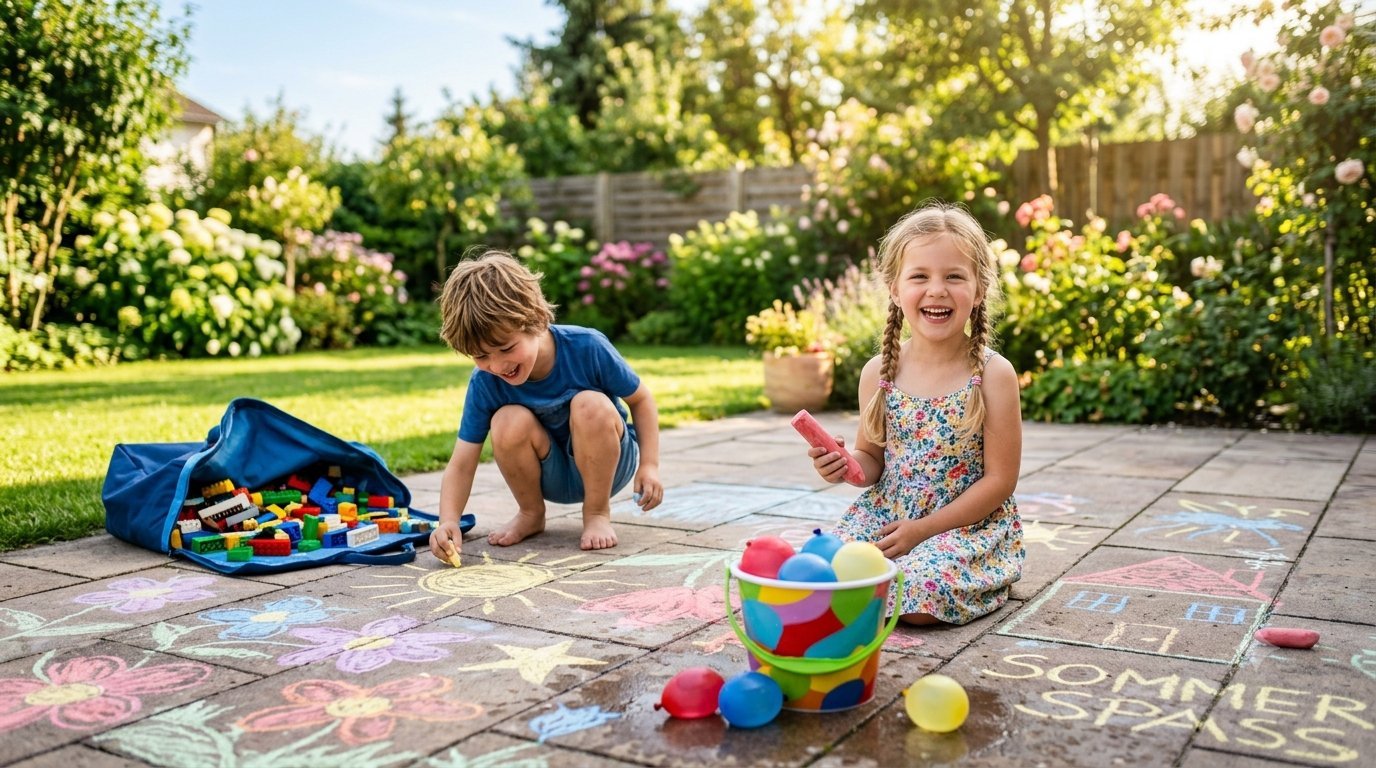
In my experience as someone who runs this site, this is one of those rare products where the design alone solves the problem – no habit-building required. The fix is a large toy storage bag with a built-in play mat – it solves the cleanup problem on a purely physical level and becomes the foundation for stress-free building and play. The principle in four steps: unfold → kids build in a circle on the mat → pull the drawstring, the mat folds itself into a bag → done, tidied up in 5 seconds.
The concept is as simple as it is clever: the product is a water-resistant, durable play mat (usually about 150 cm across) with a tall fabric rim sewn around the edge. That mat is either attached directly to a sturdy storage bin, or cinches itself into a bag via a drawstring.
- Lightning-fast tidy-up: Kids dump all their small pieces straight onto the unfolded mat. When playtime's over, you just pull the cords. Hundreds of individual pieces slide automatically to the center and disappear into the bag.
- Perfect for outdoor use: Thanks to the sturdy, wipeable material (usually nylon or polyester), the mat spreads out easily on the lawn, patio, or sand at the beach. Moisture doesn't seep through from below, and sand stays out.
- Portability: If it starts raining, you grab the carry handles and move the entire play set from the garden to the kids' room in five seconds.
| Feature | Traditional Toy Bins | Play Mat With Drawstring Bag |
|---|---|---|
| Tidy-up time | 10 to 20 minutes (piece by piece) | Under 10 seconds (pull the drawstring) |
| Visibility while playing | Kids dump everything on the floor | Everything sits clearly on the mat |
| Risk of injury | Painful stepping on small pieces | Small pieces stay confined to the mat |
| Outdoor suitability | Bulky, gets dirty | Water-resistant, easy to clean |
This product drastically reduces the friction points between parents and kids around tidying up. It turns a dreaded chore into a single motion.
Our Pick Against Toy Chaos
Large Toy Storage Bag With Built-in Play Mat
Water-resistant, durable play mat with a drawstring – tidy-up in under 10 seconds, indoors or out.
This is the one product on this whole list I'd call a no-brainer – it removes the exact friction point that turns tidy-up time into an argument, without asking your kid to change a single habit.
Creative Outdoor Projects: Adventure Right Outside Your Door
Keeping kids meaningfully occupied outside doesn't require expensive equipment. What matters far more is giving them natural materials and simple tools that leave room for discovery. Honestly, I'm not a fan of activity plans that need a shopping list before they can even start – the ideas below cost close to nothing.
The GPS-Free Explorer Scavenger Hunt
Kids love searching for and collecting things. Make a simple map or a "nature bingo" list for the garden or the local park:
- Find something soft (like moss).
- Find something with rough bark.
- Look for a stone that's been worn smooth.
- Find a dried leaf from last year.
- Spot three different insects (just observe, don't catch!).
The collected stones and sticks can then become tiny fairy or forest-spirit villages in the garden.
The Outdoor Lab: Simple Physics Experiments
Water and dirt are the best play materials in the world. Allow a "mud zone" in the garden. With old pots, spoons, and plastic bottles, you get a mud kitchen where kids can "cook soup" for hours. For basic physics experience, build simple water channels together out of bamboo rods or halved plastic bottles. Kids learn gravity, flow, and barriers through play.
The Timeless Classic for Hours of Outdoor Fun
Some toys have worked for generations, and their potential is still often underestimated. When it comes to turning paved areas in the yard, on the patio, or on the sidewalk into a creative play zone, nothing beats sidewalk chalk. My personal take is that this is the most underrated toy category out there – it's cheap, it's simple, and it consistently outperforms far more expensive gear.
Not all chalk is equal. High-quality XXL sidewalk chalk in a resealable bucket stands out with extra-thick sticks that don't snap instantly in small hands, plus highly pigmented color. It's suited for imaginative art (large murals, mandalas), movement courses (hopscotch, slalom paths), and role play (street networks for balance bikes and go-karts).
Why Sidewalk Chalk Is a Developmental All-Rounder
- Builds gross motor and graphomotor skills: Drawing on rough asphalt requires different force than drawing on paper. Kids use their whole arm, strengthening shoulder and hand muscles.
- Builds entire play worlds: Once the chalk hits the ground, kids start drawing street networks with intersections, roundabouts, and parking lots for their balance bikes, go-karts, or scooters. Whole cities emerge, complete with houses, supermarkets, and gas stations.
- Interactive rule-based games: Draw classics like hopscotch, or complicated slalom and balance paths. That brings movement, builds balance, and keeps kids active for hours.
- Leaves no trace: The biggest win for parents: the next summer rain washes the whole artwork away without a trace. Or a quick spray with the garden hose does the job – which conveniently becomes the next water game for the kids.
The bucket also means the chalk can be stored dry after playtime and easily carried along, whether to the playground or to the grandparents' house.
Our Pick for Outdoors
XXL Sidewalk Chalk in a Handy Carry Bucket
Extra-thick, highly pigmented sticks that wash away without a trace – for imaginative art, movement courses, and role play.
What sold me on this particular pick is the extra-thick format – regular chalk snaps in small hands within minutes, and that alone kills the fun faster than anything else.
Water Play and Sun Protection: Cooling Off Without Frustration or Waste
Once the thermometer climbs past 30°C (86°F), things inevitably shift toward water. But not everyone has a big pool in the yard, and daily trips to a crowded public pool are exhausting and expensive.
Set up a small water station in the shade instead. A shallow plastic tub filled with water, a few sponges, sieves, and cups is often plenty for younger kids. For older kids, water fights are the highlight of summer. But traditional single-use latex water balloons come with real downsides: filling and tying them at the tap takes forever and usually needs parental help, and after the fight, hundreds of tiny wet plastic scraps litter the grass – if they're not picked up meticulously, the lawnmower shreds them further, or pets and birds eat the hazardous rubber bits. Honestly, I genuinely think this is where classic water balloons fall apart as a summer staple, and it's worth rethinking the whole approach rather than just buying more bags of them.
The Sustainable Highlight for Hot Summer Days
To maximize water-fight fun while completely eliminating the cleanup frustration afterward, a technical innovation has taken over the toy world in recent years: self-sealing, reusable water balloons made of soft silicone with a magnetic closure.
| Traditional Single-Use Water Balloons | Silicone Water Balloons With Magnetic Closure | |
|---|---|---|
| Filling | Takes forever, needs tying | Seconds to fill, no tying needed |
| On impact | Often bursts in your hand | Only opens on impact |
| Waste | Hundreds of plastic fragments | Zero waste, 100% reusable |
The balls are made of extremely soft, skin-friendly silicone. Small, safely enclosed magnets or silicone lip-seals are built into the rim. The child simply dips the open silicone ball into a bucket of water; underwater, water pressure and the magnets snap the ball shut on their own, sealing the water inside. On impact, the seal pops open under the impact force, and the water bursts out in a big splash – the silicone cushions the hit, so there's no pain or bruising.
- Independence for kids: Even three-year-olds can refill the balls in a water bucket by themselves within two seconds. Constant parental help with tying disappears entirely.
- Sustainability: A set of 8 to 12 silicone water balloons replaces thousands of conventional single-use plastic balloons. Zero waste ends up in the yard.
- Durability: The high-quality silicone is UV-resistant, tear-resistant, and lasts for years with proper storage.
These water balloons are one of the most worthwhile summer investments a family can make – instant play value, better for the environment, and no more nerve-racking rubber-scrap cleanup for parents. This is the product on this list I'd tell a friend to buy first if she only had budget for one thing.
Our Pick for Mess-Free Water Fun
Reusable Silicone Water Balloons With Magnetic Closure
Self-sealing, filled in seconds, 100% reusable – zero plastic waste in the yard.
I recommend this one specifically because it removes the two biggest pain points at once – the endless tying at the tap and the plastic-scrap cleanup afterward – rather than just being a marginally nicer version of the same idea.
Sun Protection in Everyday Life: Simple Habits for Hot Days
None of this needs to become a big production. Sun protection works best when it's just another small habit woven into the day, the same way brushing teeth is. My own view is that this section gets overcomplicated far too often; a short, boring routine beats an elaborate one that gets skipped on busy days.
The Basics That Actually Matter
None of the following is groundbreaking, but that's exactly why it's so easy to forget in the rush of a normal day:
- Shade first: The sun is strongest around midday, roughly between noon and 3 p.m. Shift intense outdoor time to the morning or later afternoon where you can, and actively seek out shade around midday – under trees, a shade sail, or a patio umbrella.
- Clothing as the first layer: Loose, lightweight, long-sleeved clothing plus a wide-brimmed hat or one with neck coverage protects more reliably than sunscreen alone.
- Apply and reapply: Cover exposed skin regularly, and reapply after swimming or heavy sweating – sunscreen rinses off in the water faster than most people expect.
- Sunglasses with UV protection: Eyes appreciate the shade too, especially near water, where light reflects and adds to the glare.
- Keep the water bottle handy: Heat and activity outdoors add up to real fluid loss. A bottle kids can carry and open themselves is a built-in reminder to drink.
Sun Protection Around the Sandbox and Paddling Pool
Sandboxes and paddling pools are where kids linger the longest – and often exactly where the sun beats down the longest too. A shade sail or a simple, movable umbrella over the play area usually makes the single biggest difference. UV swim shirts are a handy add-on, since they stay in place through hours of splashing in a way sunscreen doesn't.
Signs It's Time for a Break
Kids get so absorbed in play that they'll happily ignore heat and thirst – which is exactly where a watchful adult comes in. Very flushed cheeks, or a child who suddenly seems unusually tired, whiny, or wound-up, are usually a simple signal: head for the shade, offer something to drink, let them rest for a bit. In the vast majority of cases, that's all it takes before they're back in the game. If discomfort persists despite shade and fluids, a call to the pediatrician is the safest move.
Make It a Routine, Not a Reminder
Sun protection is easiest when it becomes a fixed ritual before heading outside: hat on, sunscreen on, water bottle packed – done. Once kids are old enough, let them pick their own sunscreen or hat; having a say tends to make them more cooperative about it. As a general rule for very hot days, it's worth easing off the pace, building in more breaks in the shade, and checking with a pediatrician or pharmacist if you're unsure what's suitable for babies or very young children. And one thing worth repeating even though it sounds obvious: never leave kids (or pets) alone in a parked car, even briefly – the temperature inside climbs dangerously fast in the sun.
Rainy-Day Strategies: When Summer Takes a Break
I'd rather plan for this than pretend it won't happen: summer break doesn't automatically mean 86°F and sunshine. Rainy days and summer storms can sour the mood fast. To keep the TV or tablet from taking over the moment the weather turns, it helps to have thought-out indoor alternatives ready: a blanket fort built from chairs, blankets, and flashlights; a small stop-motion film production using building blocks or clay figures and a tablet; or an ice-cream lab where fruit gets pureed and frozen into homemade fruit ice.
Managing Screen Time Wisely Over Summer
Screen time doesn't have to be completely off-limits over summer, but it should be used deliberately – as one option among many, not as the automatic filler the moment anyone says they're bored. Fixed windows (say, an hour in the early afternoon) provide structure without organizing the whole day around a screen.
The Parental Mindset: Calm Instead of Full-Time Entertainer
This is the mindset shift I'd want every parent to take away from this whole guide. You don't have to run a 24/7 entertainment program. Kids benefit more from a relaxed parent offering a few good prompts than from a stressed-out parent running a jam-packed vacation calendar. That includes the art of saying no: not every request for another outing has to be granted immediately, and clear boundaries ("tidy up first, then TV") bring everyone more calm than constant negotiating.
On the Go With Kids: Travel, Day Trips, and Car Rides
Whether it's a day trip to the lake, a quick visit to grandparents, or the big summer vacation, summer is the season families are on the move the most. A little preparation turns that into fun instead of stress. I'd argue the prep matters more than the destination – a well-packed car makes almost any trip smoother than a perfectly planned itinerary with an empty glovebox.
Keeping Car Rides Low-Stress
Long car rides with kids live or die on preparation. A small, always-ready "travel box" with snacks, a water bottle, wet wipes, and one or two favorite stuffed animals saves you from digging through the trunk mid-drive. Audiobooks or a round of I-spy fill the boring stretches better than a tablet ever does, and work just as well looking out the window ("who spots a cow first?"). On longer drives, build in a short walking break every couple of hours – it does everyone good, not just the kids. Sunshades on the rear windows keep direct sun off babies and toddlers, and loose, breathable clothing beats anything warm or tight in a car that's heated up in the sun.
Flying and Public Transit
A few small tricks make flying with kids much easier: pack the favorite stuffed animal or toy in the carry-on, along with a spare outfit and enough snacks in case a connection gets delayed. Drinking or chewing during takeoff and landing – a bottle, a pacifier, or gum for older kids – helps with ear pressure. Keep essentials like medication, a spare diaper, and a favorite book in the carry-on too, just in case checked luggage takes a while to catch up.
After You Arrive: Bring the Routines Along
The biggest source of vacation stress is often not the travel itself but the completely unfamiliar surroundings. Small, familiar rituals – the usual bedtime book, their own pillow, the same wind-down routine – give kids something to hold onto even in a rental house or hotel room. It also helps to plan a genuinely quiet day right after arrival, before the sightseeing schedule kicks in, so the whole family lands a little more gently.
At a particularly warm destination, it's worth adjusting the daily schedule to the climate instead of sticking to your usual routine from home: save sightseeing and outings for the cooler morning or evening hours, and use the hot midday stretch for a nap or a quiet break in the shade. It takes some getting used to, but everyone tends to make it through the day with more energy and far less fussing.
A Compact Packing List for Outings
- Plenty of water and a few filling snacks
- Sun hat, sunscreen, and something light for shade
- One or two familiar toys or stuffed animals
- A change of clothes and some wet wipes
- A small first-aid kit with bandages for scrapes on the go
Frequently Asked Questions
How much structure do kids actually need over summer break?
Less than during the school year, but not zero. A few fixed anchor points, like in the 3-pillar system – a window for activity, one for quiet, one for open play – are usually enough. Everything else can stay spontaneous.
My child says they're bored no matter how much we offer – what should I do?
That's rarely a sign of not enough activities; it's a completely normal transition phase. Resist the urge to jump in with something new right away, and give your child a bit of time. Often, their own play idea shows up on its own soon after.
Is more screen time over summer a problem?
A bit more screen time than during the school year is normal over break and nothing to worry about. What matters more than the exact number of minutes is that it's used deliberately – as one option among many, not as the default fix for every moment of boredom.
What's the best way to prepare for a long car ride with toddlers?
A small travel box with snacks, drinks, wet wipes, and a favorite toy or two, fixed breaks every couple of hours, and audiobooks instead of a screen make for the calmest rides. You'll find more detail in the travel section above.
At what age can kids start applying their own sunscreen?
As soon as they're physically able to, letting them help under supervision is fine and tends to make them more cooperative about it. For babies and very young toddlers, shade and clothing are the first line of defense; a pediatrician or pharmacist is the best source for advice on suitable products.
How do we handle sibling fights during long, hot break days?
More time together often means more friction too. Fixed spots where each child can retreat on their own, plus the midday anchor with quiet activities, help stretch everyone's fuse a little longer.
What should always be in the bag for a summer day trip?
Enough water, a sun hat, sunscreen for reapplying, a few snacks, a change of clothes, and some kind of portable shade cover most situations, whether it's a small umbrella or a light cloth.
What if the drive to our vacation destination is especially long?
For very long stretches, it helps to deliberately schedule departure for the cooler, quieter early morning or evening hours, so kids sleep through part of the trip. Several short breaks with some fresh-air movement also make the whole drive feel far more manageable than one long, uninterrupted stretch.
Bottom Line and Checklist for Your Best Summer Break Yet
Summer with kids doesn't have to be perfectly planned out. With three daily anchors instead of a rigid schedule, the zone principle against chaos, the 15-minute micro-routine, a few good outdoor prompts, and the right tools, everyday life during the break gets noticeably calmer for everyone involved. If I had to boil this whole guide down to one sentence, it would be this: fewer rules, applied consistently, beat a perfect plan that falls apart by day three.
What are your favorite summer hacks? Let us know in the comments!
Save on Pinterest →
Comments