Table of Contents
- Why Outdoor Fall Play Is So Valuable
- Ideas 1–6: Collecting Leaves & Chestnuts
- Ideas 7–12: Movement & Outdoor Games
- Ideas 13–18: Crafts With Natural Materials
- Ideas 19–24: Observing & Exploring for Little Nature Detectives
- Ideas 25–30: Cozy Indoor Ideas After the Walk
- Getting Siblings With Different Interests Involved Together
- Activities By Age: Toddlers, Preschoolers & School-Age Kids
- In Any Weather: Rain, Wind & Foggy-Day Variations
- Dressing Right: Staying Warm and Dry Without the Stress
- Fall Break and Everyday Weeks: Using Both
- Optional Gear for Even More Fall Fun
- Turning 30 Ideas Into an Actual Fall Routine
- The Perfect Fall Walk: A Simple Routine
- Frequently Asked Questions
- Bottom Line: Fall Is the Cheapest Playground of the Year
As soon as the days get shorter and the trees turn color, many families hear the same question: "So what are we doing outside now?" And yet fall might be the cheapest season of the year for keeping kids busy for hours – nature supplies the material for free, from crunchy leaf piles to shiny chestnuts.
In this article you'll find 30 concrete ideas, sorted by category, that all work on little to no budget. Plus tips by age, weather variations for rainy days, and a short dressing guide so "staying inside" never has to be the only option.
My honest opinion, after a lot of fall afternoons spent testing this stuff: half of what gets marketed as "fall activity gear" is solving a problem a bag of chestnuts already solves for free.
Why Outdoor Fall Play Is So Valuable
Fall offers kids something that's hard to replicate indoors: constantly changing input. Unlike a toy shelf that starts feeling familiar after a few weeks, the outdoors genuinely changes day to day – a different tree drops its leaves, a new puddle shows up overnight, the air feels different than it did yesterday. Those small shifts keep curiosity alive without adults having to invent anything new.
Free play in nature also builds motor skills in ways that rarely come up indoors: balancing over uneven leaf litter, stepping over roots, handling wet, cold materials with bare hands. For a lot of kids, this unstructured setting is genuinely restful – there's no fixed goal, no score, no right or wrong, just room to explore.
And practically speaking, it's just convenient: fall nature activities generally cost nothing, need almost no prep, and work almost anywhere – from a forest trail to a backyard in the middle of the city.
There's a payoff for parents here too: a walk with no fixed destination and no phone in hand tends to feel just as relaxing for you as it does for your child. You don't have to constantly direct or entertain – often it's enough to just come along, notice things, and pick up the occasional chestnut yourself. What I like most about this particular season is that it asks so little of the adult running it – no entertaining required, just showing up.
Ideas 1–6: Collecting Leaves & Chestnuts
Collecting is the foundational activity of fall – easy to start, and almost everything else on this list builds on the results. Most kids don't need any instructions for this, just a bag and a bit of unhurried time. If I had to pick a favorite from this whole list, it would be the leaf-pile jump – it takes almost no setup and gets the biggest laughs of anything here, in my experience.
- Leaf-collecting contest: who can find the most different leaf shapes or colors? A bag or an old bucket works fine as a "collection basket."
- Chestnut critters: a few toothpicks turn chestnuts into little hedgehogs, beetles, or invented creatures.
- Leaf mandala: lay out collected leaves, pinecones, and twigs into a circular pattern right on the ground – take a photo before the wind rearranges it.
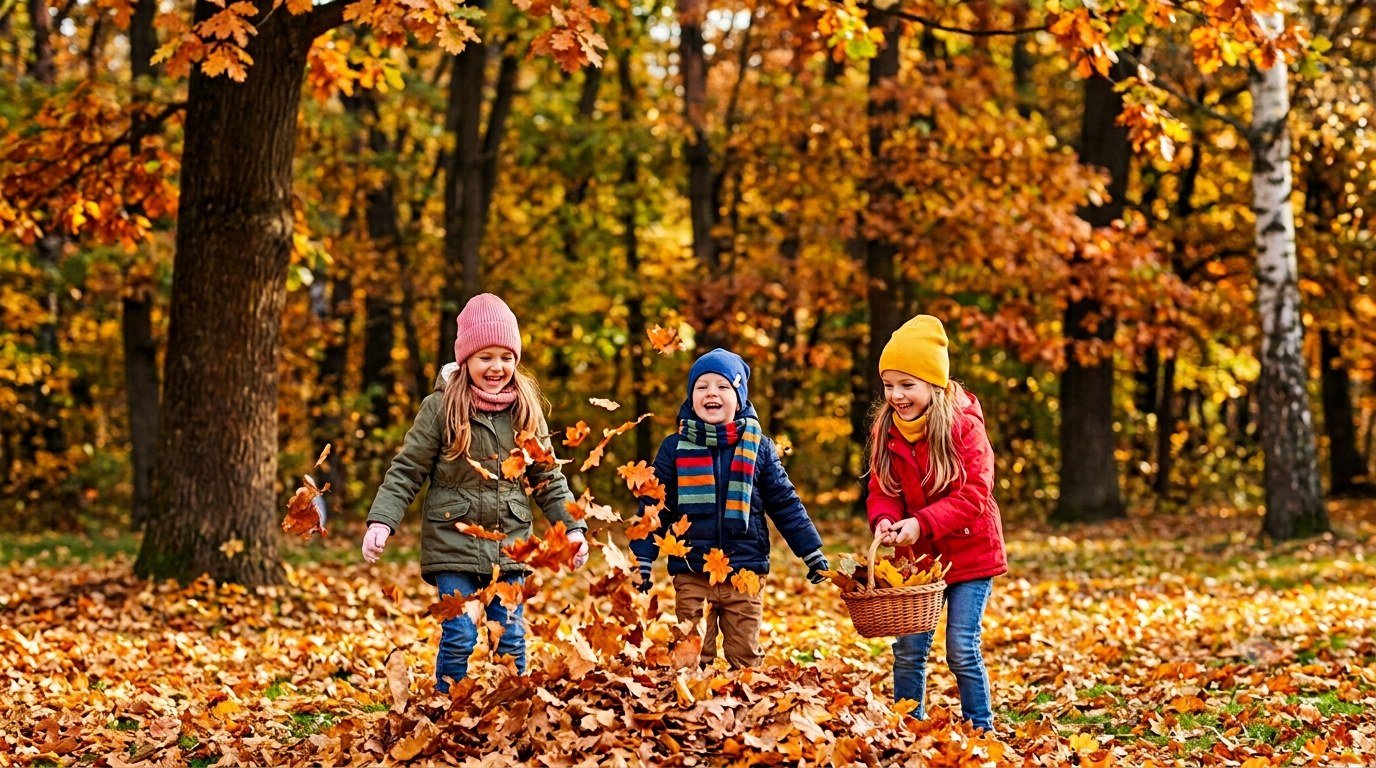
- Leaf-pile jump: rake leaves into a big pile (the raking itself is half the activity) and jump in together.
- Chestnut target toss: set up a few buckets or chalk-drawn circles as targets and toss chestnuts in.
- Leaf press: press the prettiest finds between the pages of a heavy book – ready for craft projects after a week or two.
Ideas 7–12: Movement & Outdoor Games
Moving around in cool, fresh air is often even more fun in fall than in peak summer heat – nobody overheats, and hot cocoa tastes even better afterward. On days with a lot of pent-up energy, these ideas usually work faster than any reminder to calm down. Honestly, I've stopped trying to talk a wound-up kid down with words on these days – sending that energy outside works so much faster than any conversation would.
- Leaf obstacle course: mark a small course through the yard or park using branches, stones, and puddles.
- Fly a kite: whether homemade from newspaper and string or a cheap store-bought one, fall wind is basically made for this.
- Color scavenger bike ride: ride bikes or scooters through the most colorful streets nearby and count trees in different colors along the way.
- Race to the tree: pick a landmark tree as the finish line for a quick race – great for burning off extra energy.
- Puddle jumping: after a rain shower, hop from puddle to puddle in rain boots on purpose.
- Wind race: let paper airplanes or feathers fly in the wind and race to catch them first.
Ideas 13–18: Crafts With Natural Materials
These ideas mostly need things that are already lying around the house: glue, paper, and whatever you found on the walk. It helps to think ahead a little while you're out collecting about which craft project the finds are for – saves a second trip later. My personal take is that the craft matters less than the collecting walk that comes before it – the finished leaf print rarely gets remembered, but the walk searching for the right leaf usually does.
- Chestnut figures: build little characters out of chestnuts using toothpicks, googly eyes if you have them, or just drawn-on faces.
- Leaf printing: coat leaves with watercolor paint and press them onto paper – every leaf leaves its own pattern.
- Nature mobile: tie twigs, feathers, and small leaves to a larger branch with string and hang it up.
- Painted pumpkin: instead of carving, just paint faces or patterns with watercolors or markers – doable safely even for younger kids.
- Nature collage: glue collected leaves, moss, and small twigs onto cardboard to build a picture or forest scene.
- Painted rocks: paint found rocks with fall-themed designs – a hedgehog, a pumpkin, or a simple leaf.
Ideas 19–24: Observing & Exploring for Little Nature Detectives
Fall visibly changes nature from week to week – a great excuse to actually slow down and look instead of just walking past. None of these need prior knowledge, just a little patience and the willingness to stand still for five minutes. I'm genuinely a bigger fan of these quiet observing ideas than the louder ones – they're the category that seems to calm down even kids who normally can't sit still for anything.
- Bird watching: which birds are around right now? Binoculars are a nice bonus, but not required.
- Mushroom spotting: keep an eye out for mushrooms on the trail – look and photograph only, never touch or eat, since poisonous and edible species can look confusingly similar to non-experts.
- Weather journal: a simple notebook where weather, wind, and cloud shapes get noted or drawn each day.
- Spiderweb search: cool mornings often leave spiderwebs glistening with dew – a quiet, short round of discovery.
- Earthworm expedition: earthworms surface after a rainy day, a good opening for early questions about soil and what lives in it.
- Bark rubbing: hold a sheet of paper against tree bark and rub the side of a crayon over it to reveal the pattern.
Ideas 25–30: Cozy Indoor Ideas After the Walk
After fresh air, staying inside tastes twice as good – these ideas round out a fall day without needing any more planning energy. They also work well as a stand-alone lineup for days when going outside just isn't happening. What convinces me about ending on the cocoa break specifically is the ritual of it – it turns an ordinary walk into something with a proper beginning and end, which kids notice more than you'd expect.
- Cocoa break: a warm cup of cocoa with a few marshmallows as a small ritual after every walk.
- Window art: cut colorful leaves out of tissue paper and stick them to the window – they glow with the light behind them.
- Cozy read-aloud time: a fall or Halloween book, a thick blanket, and that's the whole cozy afternoon sorted.
- Sorting and counting chestnuts: sort by size, shape, or count – a playful first step into numbers and math.
- Shadow theater: use a flashlight and the leaves you collected as shadow puppets to invent little stories on the wall.
- Rainy-day board game: a puzzle or board game you already own at the kitchen table – ideally with a second cup of cocoa.
Getting Siblings With Different Interests Involved Together
When a three-year-old and an eight-year-old need to be entertained at the same time, it helps to pick activities that scale by difficulty instead of organizing something completely different for each child. During the leaf-collecting contest, the older child can hunt for rare leaf shapes while the younger one just focuses on finding as many leaves as possible – both stay busy, and nobody feels over- or under-challenged.
For the nature collage or the chestnut figures, it works well to give the older child a small responsibility – like being in charge of the glue or the toothpicks – while the younger one picks out materials. That gives the older sibling a sense of importance without taking the activity over for the younger one.
With bigger age gaps – say, a toddler and a school-age kid – short blocks that alternate between each child's needs tend to help: ten minutes of leaf-pile jumping the older child joins even though they'd rather do something calmer, then ten minutes of the weather journal, where the younger one just sits nearby and watches. Nobody has to give up their own preference the entire time.
Sometimes it also just works better when siblings aren't doing the exact same thing side by side but their own version of it – both collecting, say, but each with their own bag and their own pace. That counts as shared time just as much, and it takes the pressure off having to force every single activity into something fully shared. My honest take is that this reframe matters more than any single activity idea in this section – "together" doesn't have to mean "identical" for it to still count.
Activities By Age: Toddlers, Preschoolers & School-Age Kids
Not every one of the 30 ideas above fits every age equally well. A quick look at typical developmental stages helps you choose more deliberately instead of just grabbing whatever's closest.
Toddlers (roughly ages 1–3)
At this age, sensory experience comes first: grabbing leaves, feeling chestnuts, stomping through leaf piles and enjoying the sound. Repetition here isn't boredom, it's exactly how toddlers really understand something, so the same leaf pile can happily get jumped in ten times in a row.
Collecting, the leaf-pile jump, and the cocoa break tend to work especially well at this age since they need little instruction and still deliver instant joy.
Preschoolers (roughly ages 3–6)
Now their own ideas start showing up: kids invent stories about their finds, want to decide what gets collected, and take real pride in small craft wins like the chestnut figures or the leaf printing. Games with rules, like the chestnut target toss, land well at this age too, as rules start to become genuinely interesting.
It helps not to steer craft results too heavily here – the process matters more than the finished picture at this stage.
School-age kids (roughly age 6+)
School-age kids often want to know why things happen – why leaves change color, why earthworms surface after rain. The weather journal, bird watching, and mushroom spotting offer more depth here, since observations can be compared across several days.
Competitive elements like the race to the tree or the leaf-collecting contest also go over well, since kids this age are starting to enjoy measuring themselves against others or their own past attempts.
As always: these age ranges are a rough guide, not a rule – some four-year-olds love long, involved craft projects, while some seven-year-olds are happiest just jumping in leaf piles. Watch what genuinely holds your child's attention, and treat this list as a menu of ideas rather than a checklist to work through in order.
Mood and energy on a given day matter just as much as age: a well-rested kid might happily sort chestnuts for an hour on a Sunday morning, while an exhausted kid on a Monday afternoon only has patience for five minutes of leaf-pile jumping. Both are completely fine.
In Any Weather: Rain, Wind & Foggy-Day Variations
Fall can bring several different kinds of weather into a single weekend – having matching ideas ready saves the debate over whether it's even worth going out. Most of the 30 ideas above adapt to the weather with little effort, no need to invent a whole new activity.
In the rain
Puddle jumping and the earthworm expedition are practically made for rainy weather. Afterward, switching indoors to window art or read-aloud time makes both feel better by contrast – wet outside, warm inside.
In the wind
Windy days are perfect for kite flying and the paper-airplane wind race. Leaves also tend to pile up especially thick after a windy night, which only makes the leaf-pile jump more rewarding.
On foggy or overcast days
Exactly the right weather for a morning spiderweb search and for calmer activities like the weather journal or bark rubbing, neither of which depends on sunshine anyway.
And on days when nothing about going outside sounds appealing: ideas 25–30 are fully indoor-friendly and still feel like fall – nobody has to wait for the weather to cooperate.
Dressing Right: Staying Warm and Dry Without the Stress
A lot of "I don't want to go outside" has less to do with the activity itself than with being cold or having wet socks. A few simple habits prevent most of those moments. My personal opinion is that this section deserves as much attention as the activity list itself – I've watched a genuinely fun afternoon get cut short entirely by one pair of wet socks.
The layering approach – several thinner layers instead of one thick coat – is the easiest to adjust on the go as activity and temperature change: shed a layer while racing around, put it back on for a quieter observation break. Waterproof (not just water-resistant) shoes turn puddles and wet grass into something to play in instead of avoid, and gloves plus a hat pay off from the first chilly mornings, not just once it's freezing.
A dry backup outfit in the car or right by the front door usually saves more nerves than checking any weather app – and then jumping into the biggest puddle is fair game.
Kids often feel cold differently than adults do, mostly because they're moving more – a kid who's constantly in motion during the leaf-pile jump or the race to the tree usually needs fewer layers than a standing-still adult would guess. A good rule of thumb: dress one layer lighter and add from a bag if needed, rather than over-bundling from the start and ending up with a sweaty, then quickly chilling, jacket mid-activity.
Fall Break and Everyday Weeks: Using Both
Fall break usually brings more time than a regular school or daycare week – a good window for the more involved ideas in this article, like a longer forest walk followed by a craft afternoon, or a whole morning built around bird watching and the weather journal.
On regular weekdays, there's often only a short window between pickup and dinner. That's exactly where the quick ideas shine: a ten-minute detour past the nearest tree for the race, a quick stop for the chestnut target toss on the way home, or simply walking straight through the leaf pile on the sidewalk instead of around it.
That combination – short everyday moments during the week, more involved outings on weekends or during break – keeps fall from only happening on a few "big" days, and spreads it across the whole season instead.
Optional Gear for Even More Fall Fun
You genuinely don't need to buy anything for the 30 ideas above. But if you're outside regularly, two small purchases can make everyday life noticeably easier – neither is required though. Both picks below are chosen deliberately to be useful across multiple years and seasons, not just to sit in a closet for a few fall weeks. I'd only buy either of these if you're genuinely outside several times a week – for occasional walks, honestly, don't bother.
If you're trying to save on the purchase, rain gear and outdoor clothing are often easy to find gently used – we cover how to shop for that well in our Secondhand & Vinted for Kids' Clothing article.
Our Recommendation
Waterproof Kids' Rain Suit
A full-coverage waterproof overall that turns puddles, wet leaves, and muddy trails into a worry-free play zone instead of a reason to say "don't get so dirty."
What I like about this one is what it changes in me as much as in my kid – I stop policing puddles and just let the walk happen.
Our Recommendation
Kids' Bug Viewer Jar
A small magnifying viewer for safely observing bugs, leaves, and other finds up close – makes the observation ideas in this article a little more exciting, without anything needing to be touched.
This is the smaller and cheaper of the two picks here, and my honest opinion is that it's also the one that earns its keep faster – a magnified beetle gets more genuine excitement than most toys I've bought.
Turning 30 Ideas Into an Actual Fall Routine
30 ideas at once is a lot – as a standing routine they work much better than as a long list you never fully get through. This is the mindset shift I'd genuinely rank above any individual idea in this whole article: a rotating routine beats a checklist every time.
A practical starting point: a small "fall box" with a paper bag for collecting, a few crayons, glue, and – if you have it – the bug viewer from above. Keep this box within reach by the door, so a spontaneous walk doesn't start with a search for supplies through the whole house.
On weekends, it helps to commit to a single idea ahead of time instead of holding all 30 in your head – something like "today we're collecting chestnuts" or "today we're doing the race-to-the-tree route." Collecting itself then naturally supplies material for the next few days' craft ideas, so one activity flows into the next.
And if a weekend ends up entirely indoors anyway: ideas 25–30 are happy to wait until there's time or energy again. There's no deadline here – fall lasts long enough for all 30 ideas, even if not every week goes perfectly.
If your family already runs on some kind of weekly structure, it's easy to slot the fall idea in as a fixed spot – something like "Saturday morning: fall walk" instead of a vague "we'll figure it out." We go into more detail on building a reliable weekly structure like that in our three-zone weekly planning method article.
The Perfect Fall Walk: A Simple Routine
If you're not sure where to start, this simple framework pairs with almost any idea in this article.
- Pack a collecting bag: a paper bag or an old tote is plenty.
- Leave the destination open: instead of a set route, just start walking and follow whatever looks interesting.
- Work in an activity along the way: a quick round of chestnut tossing or a leaf mandala, instead of just walking straight through.
- Bring finds home: for the next few days' craft ideas.
- Close with a fixed ritual: the cocoa break from this article, say, so the walk has a recognizable start and finish.
This routine deliberately works without a clock or a set length – some days it's ten minutes, others a full hour, depending on how much time and energy there is that day. The exact length matters less than the five steps staying roughly the same each time – that consistency is what turns the walk into a familiar little ritual kids look forward to, instead of a spontaneous exception.
Frequently Asked Questions
What age are these ideas suitable for?
Most ideas work from roughly age 1–2, often in a simplified form. A few, like the weather journal or bark rubbing, tend to suit preschool or school age better. See "Activities By Age" above for details.
Do I really not need to buy anything for the 30 ideas?
All 30 main ideas use things most families already have around – paper, glue, crayons, a bucket. The two products in "Optional Gear" are genuinely optional and just make a couple of ideas a bit more convenient.
What do we do when it rains?
Some ideas, like puddle jumping or the earthworm expedition, are especially good in the rain. For days when nobody wants to go out at all, ideas 25–30 are fully indoor-friendly. See "In Any Weather" above for more.
Are mushrooms in the woods dangerous for kids?
Some wild mushrooms are poisonous and hard for non-experts to tell apart from edible ones. The safest approach is to look and photograph only, never touch or taste. For specific finds, a local mushroom identification service is the best resource.
How long do collected chestnuts and leaves last?
Chestnuts usually keep for several weeks unrefrigerated before drying out or molding, so it's worth using them for crafts fairly soon. Pressed, dried leaves last much longer and work well for later craft projects.
How often should we get outside in the fall?
There's no fixed rule – what matters more than frequency is that going outside doesn't feel like an obligation. A short, relaxed walk often does more good than a long one where everyone just wants to go home.
What about storms or really bad weather?
In storm warnings or severe weather, staying inside is the right call. Ideas 25–30 in this article work especially well on those days, since none of them need an outdoor space.
What if my child gets bored after just a few ideas?
That's normal and not a sign anything's wrong. Alternating between calm ideas (like the weather journal) and active ones (like the race to the tree) tends to hold attention longer than several similar activities in a row. Our 30 Screen-Free Activities article has more ideas for times when going outside isn't an option.
Do you have ideas like this for other seasons too?
Yes – for the warmer months, see our in-depth Summer With Kids guide, with activities built for long, warm days.
How do I keep siblings with a big age gap busy together outside?
The easiest approach is activities that split by difficulty or role – a more challenging version for the older child and a simpler one for the younger child within the same activity. Parallel play, where both work on their own version side by side, works just as well.
Bottom Line: Fall Is the Cheapest Playground of the Year
You don't need a budget, elaborate planning, or a perfectly sunny day to give kids a genuinely great fall afternoon. A bag of chestnuts, a pile of leaves, and a bit of time are enough for surprisingly rich play.
Just start with a single idea that fits today's weather and mood – the rest of the list isn't going anywhere, and will happily wait for the next walk.
And if it turns out after the first few tries that one category – collecting, crafting, moving, or quiet observing – lands especially well with your child, it's completely fine to lean into that instead of forcing your way through all 30. What matters in the end isn't checking off the whole list, but how many good, free afternoons add up by the time fall is over. My personal take, after a lot of these walks myself: none of it needs to be memorable to count as worthwhile – an ordinary Tuesday spent kicking through leaves does plenty on its own.
Save on Pinterest →
Comments